Showing posts with label Victorian America. Show all posts

Wednesday, January 04, 2017

The First Temporary Insanity Defense


Dan Sickles

Daniel Sickles, New York Assemblyman, well known lady’s man, and rising star in the Democratic political machine, married Teresa Bagioli in 1852.  He was thirty three, she was fifteen.  Teresa’s family refused to give their consent to the marriage, so the couple married in a civil ceremony.  Seven months later a daughter was born.

In 1856, Sickles was elected to the U.S. Congress.  Teresa was bored and lonely in Washington.  Teresa struck up an innocent friendship with Philip Barton Key, Washington D. C. District Attorney and son of Francis Scott Key.  What began as innocent meetings soon blossomed into a romantic affair.

Precautions to elude detection were taken.  Key rented a house in a poor section of town so they could meet in private.  Despite the precautions the affair became the stuff of tittle tattle in Washington social circles.  Finally, an anonymous letter was sent to Sickles informing him that, “I do assure you he (Keys) has as much use of your wife as you do.”  Sickles confronted Teresa and after a heated, emotional, and tearful scene, forced her to sign a full confession.
The next day, Sunday February 27, 1859, Sickles spotted Key (unaware of the events of the previous night) standing in Lafayette Park across the street from the Sickles' home waving a handkerchief to get Teresa's attention. Dan Sickles saw the signal and went into a rage. He rushed across the street armed with several pistols and said, “Key, you scoundrel, you have dishonored my home; you must die.”

Sickles fired at close range but only slightly wounded Key's hand. Key grabbed Sickles and the two men wrestled. Sickles drew another pistol and fired again. Key fell to the ground and Sickles fired a third shot into Key’s chest.  Horrified onlookers took Key to a nearby house where he soon died.

Sickles was arrested for murder. In an unprecedented legal strategy, Sickles pled innocent by reason of insanity.  This was the first use of a temporary insanity defense in the United States.  The attorney for the defense argued that Sickles had been driven insane by his wife's infidelity.  The jury agreed and acquitted Sickles.  Sickles publicly forgave Teresa, and “withdrew” briefly from public life, although he did not resign from Congress.

Sickles weathered the public outrage over his forgiveness of the adulteress Teresa and went on to become a Major General in the Union army during the Civil War. 


We think we know the Victorians, but do we? The same passions, strengths and weaknesses that exist now, existed then, but people organized themselves very differently.


Tuesday, February 02, 2016

Love, Sex and Marriage in Victorian Times

Queen Victoria reigned over the British Empire, the largest and most diverse empire the world has ever known, from 1837-1901, and gave her name to the age. Among other things the Victorian Age has become known for its sexual prudery. In many things, including social customs, the United States mirrored what was happening across the sea in Britain. Women were allotted a subsidiary role, with patience and self-sacrifice the prime feminine virtues. Motherhood was idealized, alongside virginal innocence. The ideal of purity in sexual behavior became sacrosanct, at least in public


We think we know the Victorians, but do we? The same passions, strengths and weaknesses that exist now, existed then, but people organized themselves very differently.

Friday, February 22, 2013

Divorce in Victorian Times

Horace Greeley

Laws concerning divorce varied widely among the states throughout much of American history. In New England, where the Puritans had defined marriage as a civil contract rather than a religious sacrament, secular law had provided for divorce as early as the 17th century. Like any other contract, the marriage bond could be broken when either of the contracting parties failed to meet the obligations it imposed. Adultery, impotence, desertion, or conviction for serious crimes, were all grounds for divorce. Additionally, wives could obtain a divorce on the grounds of non-support.


In most states in the early 19th century, an act of the legislature was required to end a marriage. As the century progressed divorce laws became more liberal. During the 1850s, Indiana was widely condemned for its liberal ways. A couple in Indiana could obtain a divorce on any grounds that a judge ruled “proper”. Indiana judges were far more permissive than the New York City judge who in 1861 refused to grant a divorce to a wife whose husband had beaten her unconscious in an argument over letting the family dog sleep on the bed. The judge advised the woman that “one or two acts of cruel treatment” were not proper grounds for divorce. Indiana’s liberal stance on divorce attracted a flood of applicants from other states. The influential newspaper editor and future presidential nominee, Horace Greeley denounced Indiana as “the paradise of free-lovers” whose example would soon lead to “a general profligacy and corruption such as this country has never known.”


Thursday, February 21, 2013

Free Love in Victorian Times


Victoria Woodhull
"High priestess of Free Love"

In the state of New York, the Oneida Community, founded in 1848, described marriage as, “contrary to natural liberty....a cruel and oppressive method of uniting the sexes.” This group practiced a form of community marriage where each woman was married to every man and each man to every woman. The Oneida Community “[rejects] conventional marriage both as a form of legalism from which Christians should be free and as a selfish institution in which men exerted rights of ownership over women”. The movement’s founder, John Humphrey Noyes coined the term “free love” and found scriptural justification for the concept: “In the resurrection they neither marry nor are given in marriage, but are like the angels in heaven” (Matt. 22:30). The Oneida Community lived together as a single large group and shared parental responsibilities.

The concept of “free love” blossomed outside of the Oneida Community. Victoria Woodhull, the first woman to run for president (1872), was called “the high priestess of free love”. In 1871, Woodhull wrote:

“Yes, I am a Free Lover. I have an inalienable, constitutional and natural right to love whom I may, to love as long or as short a period as I can; to change that love every day if I please, and with that right neither you nor any law you can frame have any right to interfere. And I have the further right to demand a free and unrestricted exercise of that right, and it is your duty not only to accord it, but, as a community, to see that I am protected in it. I trust that I am fully understood, for I mean just that, and nothing less!”

Woodhull received fewer than sixteen thousand votes nationwide. Most Americans rejected alternative forms of marriage and pressured young people to marry conventionally. A man's credit rating depended in part on whether or not he was conventionally married and had children.


My titles on Amazon   My titles at Barnes & Noble


The best reading experience on your Android phone or tablet, iPad, iPhone, Mac, Windows 8 PC or tablet, BlackBerry, or Windows Phone.

Monday, February 18, 2013

The Social Purity Movement and Family Planning


By the 1870s, couples in all classes were choosing to limit and plan family size “by a variety of methods within a culture of abstinence”. “Considerate” husbands, who did not insist on intercourse, were admired, not least because of the high mortality rate among pregnant women. It was perhaps a good thing that husbands had decided to privately abstain from sex, since by the mid 1870’s the United States government had invaded every bedroom in the nation. In the 1870’s a “social purity movement”, spurred on by evangelical Protestant moral reformers launched a crusade against vice, including contraception, which was considered to “lead to lewd, immoral behavior and promote promiscuity”. It is not surprising that such a movement arose. The industrialization that swept America during and after the Civil War ushered in morality problems such as widespread prostitution. As urbanization flourished so did prostitution. The majority of prostitutes were young, illiterate, and poor. Higher wages for less work appealed to many young women. With little in the way of birth control, frequent pregnancies occurred among prostitutes. Since being pregnant would put them out of work, abortion became the alternative for the tens of thousands of prostitutes in America’s teeming cities. The moral laxness sweeping much of America began to impact public opinion. Social purity advocates proclaimed, “Social crimes like infanticide, that were once placed on the same level as murder, are now not only looked upon with complacency... but are defended on principle by certain theorists.”


The social purity movement successfully pressured Congress into passing the Comstock Act (named after the movement’s leader Anthony Comstock) in 1873. The Comstock Act was a federal law which, among other things, prohibited mailing, “any article or thing designed or intended for the prevention of conception or procuring of abortion”, as well as any form of contraceptive information. Twenty four states passed similar state laws (collectively known as the Comstock Laws), sometimes extending the federal law by outlawing the use of contraceptives, as well as their distribution. The most restrictive state laws of all were in Connecticut. Married couples could be arrested for using birth control in the privacy of their own bedrooms, and subjected to a one-year prison sentence. As late as 1960, thirty states had statutes on the books (inspired by the Comstock Laws) prohibiting or restricting the sale and advertisement of contraceptive devices.

My titles on Amazon   My titles at Barnes & Noble


The best reading experience on your Android phone or tablet, iPad, iPhone, Mac, Windows 8 PC or tablet, BlackBerry, or Windows Phone.

Wednesday, January 23, 2013

Love, Sex and Marriage in Victorian America


Queen Victoria reigned over the British Empire, the largest and most diverse empire the world has ever known, from 1837-1901, and gave her name to the age. Among other things the Victorian Age has become known for its sexual prudery. In many things, including social customs, the United States mirrored what was happening across the sea in Britain. Women were allotted a subsidiary role, with patience and self-sacrifice the prime feminine virtues. Motherhood was idealized, alongside virginal innocence. The ideal of purity in sexual behavior became sacrosanct, at least in public.


No one better exemplifies the popular notion of the buttoned up old maid Victorian American prude than purity crusader Carry Nation. Carry Nation is best remembered for crusading against alcohol, but she was also enthusiastically against tobacco, politicians, and sex. She lectured young couples on the evils of buggy riding, she stopped women on the street to warn them against the dangers of seduction, and she wrote a newspaper column whose main theme was the evil of self abuse. After two disastrous marriages, in which her husbands resented her overzealous Christianity and she resented their overzealous embraces, Carry Nation concluded that men were, “…nicotine soaked, beer-besmeared, whiskey-greased, red-eyed devils” and “two-legged animated whiskey flasks.”

  People like Carry Nation have given us a view of Victorian America.  We think we know the Victorians, but do we? The same passions, strengths and weaknesses that exist now, existed then, but people organized themselves very differently.   Read more in:  Love, Sex and Marriage in Victorian America    

  My titles on Amazon   My titles at Barnes & Noble


The best reading experience on your Android phone or tablet, iPad, iPhone, Mac, Windows 8 PC or tablet, BlackBerry, or Windows Phone.

Sunday, January 13, 2013

Grover Cleveland: The Philandering President


Victorian America had its share of philandering politicians, including Grover Cleveland the 22nd and 24th President of the United States (the only U.S. president to serve two non-consecutive terms 1885-1889 and 1893-1897).

During the election of 1884, Cleveland’s Republican opponents discovered reports that Cleveland had fathered an illegitimate son while he was a lawyer in Buffalo, and chanted “Ma, Ma, where's my Pa?” in derision. Cleveland admitted to paying child support in 1874 to Maria Halpin, for the maintenance of her son Oscar Folsom Cleveland. Maria Halpin had been involved with several men while an intimate of Cleveland’s, including Cleveland's law partner, Oscar Folsom, for whom the child was also named. Grover Cleveland did not know who the father was, but assumed responsibility.

Despite the scandal, Cleveland won the presidential election of 1884. His backers turned the Republican attack phrase, “Ma, Ma, where’s my Pa?” into a victory slogan, “Ma, Ma, where’s my Pa? Gone to the White House Ha! Ha! Ha!”

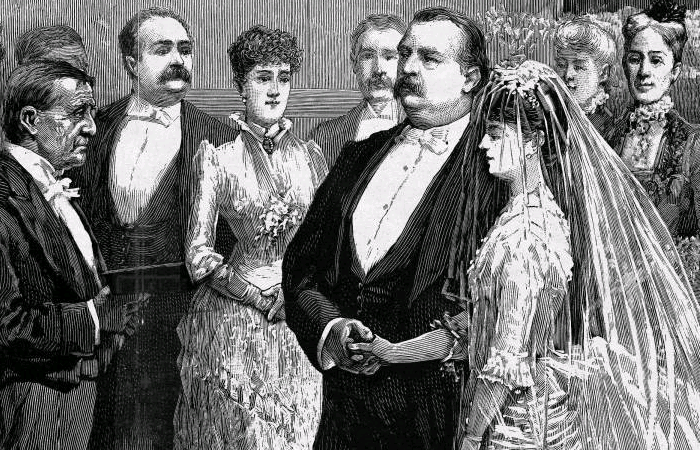
Two years after the election, the first presidential marriage to occur in the White House united Grover Cleveland (49) and Frances Folsom (22). Frances was the daughter of Cleveland’s old law partner Oscar Folsom. Cleveland was the executor of Oscar Folsom's estate and had supervised Frances' upbringing after her father's death. Cleveland had known Frances from babyhood and had helped to buy her first baby carriage. A regular visitor to the Folsom house, Cleveland had taken Frances toys. When Frances went off to college, her room was kept bright with flowers from “Uncle Cleve.” For his part, Cleveland confided to his sister that he was, “waiting for his wife to grow up.”

The American public was enchanted with the match and the marriage was a success. The Cleveland’s had five children and were happily married for some twenty two years.


My titles on Amazon  

My titles at Barnes & Noble


The best reading experience on your Android phone or tablet, iPad, iPhone, Mac, Windows 8 PC or tablet, BlackBerry, or Windows Phone.