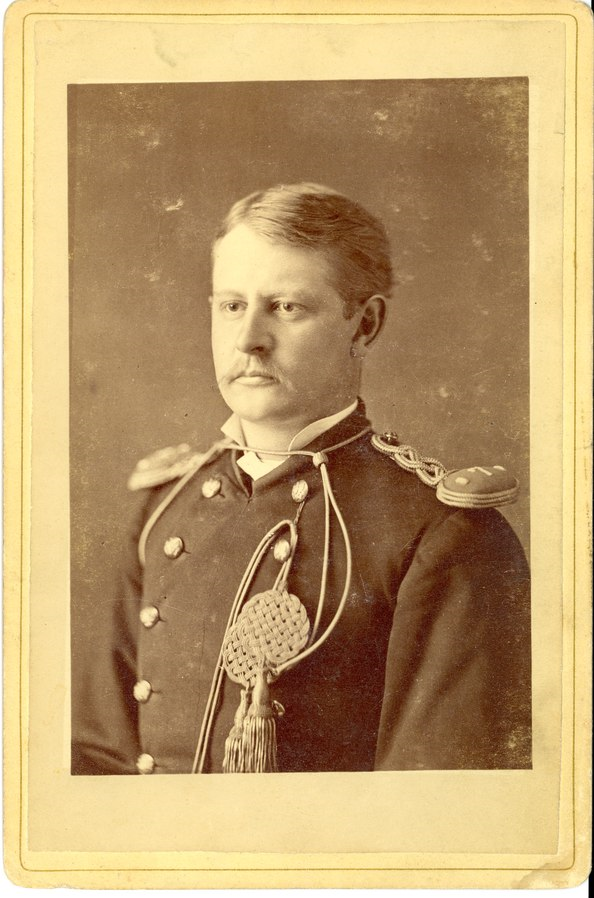
Charles Windolph, born in
1851 in Germany, immigrated to the U.S. and joined the 7th Cavalry. At the
Battle of the Little Bighorn in June 1876, he served under Captain Benteen. As
Custer’s command fell, Windolph’s unit survived a brutal siege on Reno Hill.
Braving enemy fire, he volunteered to fetch water for the wounded, earning the
Medal of Honor. Promoted to sergeant, he later settled in South Dakota, working
for Homestake Mining. Windolph, the last white survivor, died in 1950 at 98, leaving
a vivid memoir, I Fought with Custer.
Tom Custer, the younger brother of
George Armstrong Custer earned two Medals of Honor during the Civil War. After
the Civil War, Tom followed George into the Regular Army, joining the 7th
Cavalry Regiment in 1866 as a second lieutenant. Tom served under his brother.
Tom Custer participated in the 1873
Yellowstone Expedition and the 1874 Black Hills Expedition. Tom rose to the
rank of captain by 1875, commanding Company C.
Rain-in-the-Face, born around 1835
was a formidable Lakota war chief known for his fierce reputation. His name,
originated after a childhood fight where his face was streaked with blood.
During the 1873 Yellowstone
Expedition two civilians attached to the expedition—veterinarian John Honsinger
and sutler Augustus Baliran—were killed by Lakota warriors. Rain-in-the-Face
later confessed to these killings, claiming he acted to prove his bravery after
a taunting challenge from a young woman.
Sixteen months later, in 1874, guide
Charley Reynolds identified Rain-in-the-Face at the Standing Rock Agency,
reenacting the killings during a ceremonial dance. George Custer, commanding
Fort Abraham Lincoln, dispatched Tom Custer and Captain George Yates with two
companies of the 7th Cavalry to arrest him.
The arrest was dramatic: Tom Custer entered
the agency store, waited for Rain-in-the-Face to appear and subdued him in a
physical struggle. Rain-in-the-Face, humiliated by the public arrest and
subsequent imprisonment at Fort Abraham Lincoln, vowed revenge, reportedly
threatening to kill Tom Custer and “eat his heart.”
Rain-in-the-Face’s escaped from the
fort’s guardhouse three months later. Before fleeing, he reiterated his threat
against Tom, sending a chilling message via a buffalo skin painted with a
bloody heart. This act cemented his resolve to confront the Custers,
particularly Tom, whom he held responsible for his humiliation.
Rain-in-the-Face joined Sitting Bull’s band in the Powder River country.
The climax of their conflict came at
the Battle of the Little Bighorn on June 25, 1876. Rain-in-the-Face, now a
leading warrior, fought among thousands of Lakota, Cheyenne, and other allied
tribes against the 7th Cavalry. Tom Custer, commanding Company C, was part of
his brother’s doomed battalion.
In later accounts, Rain-in-the-Face
claimed to have killed both George and Tom Custer. He claimed he recognized Tom
during the battle, shot him and then cut out his heart to fulfill his vow. This
gruesome act was popularized by Henry Wadsworth Longfellow’s poem, “The Revenge
of Rain-in-the-Face.”
Tom Custer’s body, found near his
brother’s, was indeed badly mutilated. He was disemboweled and his head was crushed
in by a blow from a stone hammer used by the Indians. His heart, however, had not been removed according to those
who found the body.
In a 1905 interview
Rain-in-the-Face, then frail and near death, denied killing either Custer
brother or mutilating Tom, describing the battle as too chaotic to identify
specific enemies. This account is considered more reliable than the earlier
1894 interview where he was intoxicated and boasted of killing Tom Custer.
On June 25, 1876, at the Battle of the Little Bighorn,
five companies of the U.S. Seventh Cavalry, under the direct command of George
Armstrong Custer were wiped out.
Amid the chaos of that day, one
figure often overlooked emerges: Isaiah Dorman, the only African American
killed in the battle. As a skilled interpreter for the U.S. Army, Dorman's life
bridged worlds—Black, White, and Native.His death encapsulated the brutal ironies of the Indian Wars.
Isaiah Dorman's early life remains
shrouded in mystery. Born around 1832 in Pennsylvania, he was likely freeborn,
with a father of African-Jamaican descent and a mother of mixed African and Native
American heritage. By the 1850s, Dorman was in the Dakota Territory working as
a trapper, trader, and laborer. He married Celeste St. Pierre, a young woman
from the Santee Sioux band led by Inkpaduta, and integrated deeply into Native
life. Dorman was described as a large, dark-skinned man. There are no
authenticated surviving photographs of Dorman
In spring 1876, Dorman joined
Custer's 7th Cavalry expedition against the Lakota and Cheyenne, hired as a
civilian Sioux interpreter at a premium rate due to his expertise and connections,
including friendships with figures like Chief Sitting Bull. The campaign aimed
to force non-reservation tribes onto designated lands amid gold rush tensions
in the Black Hills. Departing from Fort Abraham Lincoln, the force marched
toward the Little Bighorn River, unaware of the massive Native encampment
ahead—estimated at 7,000 people, including 1,500-2,000 warriors.
On June 25, 1876 when Custer divided
his 600 men into battalions, Dorman rode with Major Marcus Reno's detachment of
about 140 troops, tasked with attacking the village from the south. As Reno's
men charged into the valley, they met fierce resistance from Lakota and
Cheyenne warriors. Reno ordered a retreat across the river to defensive bluffs,
but Dorman fell behind. Eyewitness Private Roman Rutten recalled seeing Dorman
on one knee, methodically firing a non-regulation sporting rifle at advancing
Indian warriors, shouting, "Goodbye, Rutten!" as the soldier galloped
past. An Indian account described: "We passed a black man in a soldier's
uniform... He turned on his horse and shot an Indian right through the heart.
Then the Indians fired... and riddled his horse with bullets. His horse fell
over on his back and the black man could not get up."
Accounts of his final moments vary
but paint a grim picture. One narrative claims Sitting Bull, recognizing his
old acquaintance, dismounted, offered water from a buffalo horn cup, and said,
"Don't kill that man, he is a friend of mine," before riding on.
However, many are skeptical of this story. Moving Robe Woman (Eagle Robe), shot
him in revenge for her brother's death, after which a group of Lakota women tortured
him with stone hammers and knives.His
body was mutilated—arrows embedded, slashes across the face and body, and a
16-by-2-inch strip of skin removed as a war trophy by his wife's niece, Iron
Antelope, later preserved in a North Dakota museum. Private William Slaper
described finding the corpse "with many arrows shot into his body and
head, badly cut and slashed." These acts reflected Native beliefs that
wounds would carry into the afterlife, punishing Dorman for siding with the
"bluecoats" against his adopted people.
Elizabeth Thompson’s (Lady Butler) Remnants
of an Army (1879) is a depiction of the aftermath of the British retreat
from Kabul during the First Anglo-Afghan War in 1842. The painting captures the
sole survivor of a 16,000-strong British force, Dr. William Brydon, arriving at
Jalalabad.
The composition centers on Brydon,
slumped on a weary horse, his face gaunt and eyes hollow, embodying exhaustion
and survival. The stark, snowy landscape amplifies the desolation, with muted
colors evoking a sense of loss. Butler’s attention to detail—Brydon’s tattered
uniform, the horse’s drooping head—conveys the physical and emotional toll of
the retreat. Unlike typical Victorian military art glorifying triumph, this
painting subverts convention, focusing on defeat and resilience.
Historically, the retreat from Kabul
was a disaster, with the British column decimated by Afghan tribesmen and harsh
winter conditions. Butler, known for her empathetic portrayals of soldiers,
uses Brydon’s survival to highlight individual endurance.
The Battle of
Isandlwana, fought on January 22, 1879, less than three years after Custer’s
last stand at the Battle of the Little Bighorn, was one of the most
catastrophic defeats in British military history.
On June 25, 1876, at theBattle of the Little Bighorn, five companies of the U.S. Seventh
Cavalry, some 210 men, under the direct command of George Armstrong Custer were
wiped out.The results of the Battle of Isandlwana
would be far worse.
The Anglo-Zulu War stemmed from
British ambitions to confederate South Africa under their control. High
Commissioner Sir Henry Bartle Frere, without explicit approval from London,
issued an ultimatum to the Zulu king Cetshwayo on December 11, 1878, demanding
the Zulu disband their 35,000–50,000-strong army, accept a British resident,
and become a British client state.
When Cetshwayo refused,
Lieutenant-General Lord Chelmsford, commanding British forces, launched an
invasion with 16,500 troops, including 7,000 British regulars, African
auxiliaries, and colonial volunteers, equipped with Martini-Henry rifles,
artillery, and two Gatling guns.
The Zulus relied on their
traditional "buffalo horns" formation—encircling enemies with flanking
horns while the center engaged—using short stabbing spears, cowhide shields,
and limited, outdated muskets.
Chelmsford’s divided his forces into
three columns all converging on the Zulu capital, Ulundi. The central column,
under his direct command, crossed the Buffalo River at Rorke’s Drift on January
11, 1879, and established a camp at Isandlwana, 10 miles into Zululand. The
site, beneath the rocky outcrop of Isandlwana hill, was chosen for its open
terrain but was left unfortified. Chelmsford underestimated the Zulu’s speed,
intelligence network, and resolve, assuming their forces were far away and
disorganized.
On the morning of January 22,
Chelmsford split his force, taking 2,500 men to scout for the Zulu army.The camp now housed about 1,700 men,
including 900 British regulars, 400 colonial troops, and 400 African
auxiliaries, under the command of Colonel Henry Pulleine.Unbeknownst to Chelmsford, a Zulu army of 25,000
warriors was closing in.
Colonel Anthony Durnford arrived with 500
mounted troops to reinforce the position but, acting on a scout’s report, led a
detachment to pursue a supposed Zulu retreat.
Around 8 a.m., a British scouting
party stumbled upon the Zulu army concealed in a valley 5 miles east. The
Zulus, initially resting, sprang into action, launching a coordinated assault
by 10:30 a.m. Their buffalo horns formation unfolded with devastating
precision: the left horn swept around the British right flank, the right horn
targeted the left, and the central “chest” pressed forward. Pulleine deployed
his troops in an extended firing line to maximize their Martini-Henry rifles’
range, but the line was too thin, stretching over a mile. The Zulu advance,
moving at a disciplined jog, absorbed heavy casualties but closed the distance
rapidly, exploiting the open terrain.
By noon, the situation deteriorated.
Durnford’s detachment, returning from their pursuit, was cut off by the Zulu
left horn and overwhelmed; Durnford was killed. The British line, hampered by
the too slow dispersal of reserve ammunition during the fight began to buckle.
Zulu warriors infiltrated gaps, targeting tents and wagons, disrupting resupply
efforts. The Zulu horns completed their encirclement, and hand-to-hand combat
ensued. The British, trained for disciplined volleys, were ill-prepared for the
Zulus’ close-quarters ferocity. By 2 p.m., the camp was overrun. Pulleine,
realizing defeat, reportedly handed the regimental colors to a lieutenant for
safekeeping before being killed. Of the 1,700 defenders, over 1,300 perished,
including 52 officers, 727 British regulars, 471 African and colonial troops,
and others. Zulu losses were heavy—estimated at 1,000–2,000 killed—but they
captured 1,000 rifles, two cannons, and vast ammunition stores.
This
iconic oil painting, created by British painter Elizabeth Thompson (Lady
Butler) in 1881, depicts the charge of the Royal Scots Greys, a British heavy
cavalry regiment, at the Battle of Waterloo in 1815. The painting captures the
moment the cavalry begins its charge, with dynamic composition and vivid colors
emphasizing the bravery and motion of the horses and cavalrymen. Despite historical
inaccuracies (the charge was at a slower pace due to muddy terrain), it remains
a celebrated image of valor.
Widely reproduced and regarded as an
emblem of courage, it reflects Thompson’s fame for depicting ordinary soldiers’
heroism, shaped by her observations of cavalry exercises. It is held at the
Leeds Art Gallery in the United Kingdom.
Christopher Columbus, the famed
explorer whose voyages reshaped the world, died in 1506 in Valladolid, Spain.
Yet, the journey of his remains across continents and centuries is a saga as
complex and contentious as his life.
After his death on May 20, 1506, at
the age of fifty-four, Columbus was buried modestly in Valladolid, Spain. His
remains were soon moved to a monastery in Seville, Spain, per the wishes of his
family. By 1537, his body was shipped to the island of Hispaniola (modern-day
Dominican Republic and Haiti), where Columbus had requested to be buried before
his death. He was interred in the cathedral of Santo Domingo.
When Spain ceded Hispaniola to France
in the early 1790s. Spanish authorities, unwilling to leave Columbus’ remains
under French control, exhumed his bones and shipped them to Havana, Cuba.
There, the remains were placed in a grand monument in Havana’s cathedral,
reflecting Spain’s desire to maintain Columbus as a national hero.
In 1877, workers in Santo Domingo’s
cathedral uncovered a lead box inscribed with Columbus’ name, containing bones.
This discovery sparked a heated dispute. The Dominican Republic claimed these
were the true remains, arguing that the Spanish had mistakenly taken someone
else’s bones to Havana in the 1790s. Spain, however, insisted that the Havana
remains were authentic. The debate raged without resolution, as both nations
clung to their claims for cultural and historical prestige.
When Cuba gained independence from
Spain in 1898 following the Spanish-American War, Columbus’ Havana remains were
moved again, this time back to Seville, Spain. They were placed in the Seville
Cathedral, where they remain today in a grand tomb carried by statues
representing the four kingdoms of Spain. Meanwhile, the Dominican Republic
continues to assert that the bones in Santo Domingo are Columbus’, housing them
in a monumental lighthouse, the Faro a Colón, built in 1992.
Modern science has attempted to
settle the dispute. In 2003, Spanish researchers conducted DNA analysis on the
Seville remains, comparing them to the known DNA of Columbus’ brother Diego and
his son Hernando, both buried in Spain. The results confirmed a mitochondrial
DNA match, strongly suggesting that the Seville bones are indeed Columbus’.
However, the Dominican Republic has not allowed similar testing on the Santo
Domingo remains, citing their national heritage status, leaving the question
open to speculation.
Further complicating matters, some
historians suggest Columbus’ remains may have been fragmented, with parts left
in Santo Domingo and others taken to Havana, then Seville. Without
comprehensive testing, this theory remains unproven. The lack of definitive
evidence fuels ongoing debate, with both Spain and the Dominican Republic
maintaining their claims.
In July
1862, Congress authorized a Medal of Honor to be awarded to soldiers who
“distinguish themselves by their gallantry in action.” The first medals were presented in 1863, and it remains the
highest decoration for valor the United States can bestow on an individual in
the armed services. There were 421 Medals of Honor awarded during the
Indian Wars from 1865 to 1891.
Twenty-four
individuals received the Medal of Honor for actions during the Battle of the Little Bighorn,
specifically for actions in defense of Reno Hill. These medals were awarded in 1878.
Name
Rank and Organization
Date of Action
Citation Summary
Neil
Bancroft
Private,
Company A, 7th U.S. Cavalry
Jun
25, 1876
Brought
water for the wounded under heavy fire.
Abram
B. Brant
Private,
Company D, 7th U.S. Cavalry
Jun
25, 1876
Brought
water for the wounded under heavy fire.
Thomas
J. Callan
Private,
Company B, 7th U.S. Cavalry
Jun
25–26, 1876
Obtained
water for the wounded and assisted in driving away Indians.
Benjamin
C. Criswell
Sergeant,
Company B, 7th U.S. Cavalry
Jun
25, 1876
Rescued
Lt. Hodgson's body, brought ammunition, encouraged men under heavy fire.
Charles
Cunningham
Corporal,
Company B, 7th U.S. Cavalry
Jun
25, 1876
Fought
bravely despite being wounded, declined to leave the line.
Frederick
Deetline
Private,
Company D, 7th U.S. Cavalry
Jun
25, 1876
Voluntarily
brought water to the wounded under fire.
George
Geiger
Sergeant,
Company H, 7th U.S. Cavalry
Jun
25, 1876
Held
a position securing water for the command with comrades.
Theodore
W. Goldin
Private,
Company G, 7th U.S. Cavalry
Jun
26, 1876
Part
of a party bringing water to the wounded under heavy fire.
Richard
P. Hanley
Sergeant,
Company C, 7th U.S. Cavalry
Jun
25, 1876
Recaptured
a stampeded pack mule with ammunition under 20 minutes of fire.
David
W. Harris
Private,
Company A, 7th U.S. Cavalry
Jun
25, 1876
Brought
water to the wounded at great danger under heavy fire.
William
M. Harris
Private,
Company D, 7th U.S. Cavalry
Jun
25, 1876
Voluntarily
brought water to the wounded under fire.
Henry
Holden
Private,
Company D, 7th U.S. Cavalry
Jun
25, 1876
Brought
up ammunition under heavy fire.
Rufus
D. Hutchinson
Sergeant,
Company B, 7th U.S. Cavalry
Jun
25, 1876
Guarded
and carried the wounded, brought water, directed men under fire.
Henry
W. B. Mechlin
Blacksmith,
Company H, 7th U.S. Cavalry
Jun
25, 1876
Held
a position securing water for the command with comrades.
Thomas
Murray
Sergeant,
Company B, 7th U.S. Cavalry
Jun
25, 1876
Brought
up pack train and rations on the second day under heavy fire.
James
Pym
Private,
Company B, 7th U.S. Cavalry
Jun
25, 1876
Voluntarily
went for water under heavy fire.
Stanislaus
Roy
Sergeant,
Company A, 7th U.S. Cavalry
Jun
25, 1876
Brought
water to the wounded at great danger under heavy fire.
George
D. Scott
Private,
Company D, 7th U.S. Cavalry
Jun
25–26, 1876
Voluntarily
brought water to the wounded under fire.
Thomas
W. Stivers
Private,
Company D, 7th U.S. Cavalry
Jun
25–26, 1876
Voluntarily
brought water to the wounded under fire.
Peter
Thompson
Private,
Company C, 7th U.S. Cavalry
Jun
25, 1876
Brought
water to the wounded, made two trips despite being shot through the head.
Frank
Tolan
Private,
Company D, 7th U.S. Cavalry
Jun
25, 1876
Voluntarily
brought water to the wounded under fire.
Otto
Voit
Saddler,
Company H, 7th U.S. Cavalry
Jun
25, 1876
Held
an exposed position with comrades, diverting fire for over 20 minutes.
Charles
H. Welch
Sergeant,
Company D, 7th U.S. Cavalry
Jun
25–26, 1876
Voluntarily
brought water to the wounded under fire.
Charles
Windolph
Private,
Company H, 7th U.S. Cavalry
Jun
25–26, 1876
Held
a position securing water for the command with comrades during the
engagement.
On June 25, 1876, at theBattle of the Little Bighorn, five companies of the U.S. Seventh
Cavalry, under the direct command of George Armstrong Custer were wiped
out.Among the dead was:
First Lieutenant James
Calhoun was born in Cincinnati, Ohio, in 1845. He enlisted in the Union Army in 1864 . By the
end of the Civil War, he held the rank of sergeant.
After the war, Calhoun accepted a commission as a 2nd Lieutenant
in the infantry and served in the western territories. He marriedMargaret
“Maggie” Custer, sister
of George Armstrong Custer, in 1872. This connection brought him into the inner
circle of the so-called “Custer Clan.”
Calhoun was promoted to 1st Lieutenantand
transferred to Company C of the 7th U.S.Cavalry, which was commanded by Captain Tom Custer, George’s brother. At
the Battle
of the LittleBighorn in 1876, Calhoun was acting
commander of Company C, as Tom Custer was serving as aide-de-camp to his
brother. Calhoun and his men made their last stand on what is now known as Calhoun Hill, where evidence suggests they fought
fiercely before being overwhelmed.
He was initially buried on the battlefield. His remains were later moved to Fort Leavenworth
Calhoun was nicknamed “The Adonis of the Seventh” because of his striking
appearance.
On June 25, 1876, at theBattle of the Little Bighorn, five companies of the U.S. Seventh
Cavalry, under the direct command of George Armstrong Custer were wiped
out.Among the dead was:
First Lieutenant William W. Cooke, a Canadian who was the Regimental Adjutant and
was known as "Queen's Own" Cooke.
Cooke was known for his long side whiskers that
he always wore.
Cooke was awarded brevet promotions to captain, major and
lieutenant colonel for this bravery during the Civil War. He joined the Regular Army after the War and
was made a second lieutenant in the 7th Cavalry in 1866.
In 1868 he participated in the Washita Campaign. At the Battle of the Washita, Cooke, one of
the best shots in the regiment, commanded forty sharpshooters. Cooke’s men hid themselves on the northern
side of the river and shot down Cheyenne fleeing Custer’s charge. Chief Black Kettle and his wife Medicine
Woman Later were killed by Cooke’s sharpshooters.
In 1871Cooke became the regimental adjutant reporting to
Custer. Cooke became a close friend of
Tom Custer and became part of what was known as the Custer Gang, a close-knit
group of Custer’s friends and relatives.
The anti-Custer faction within the regiment, including
Captain Frederick Benteen and Major Marcus Reno, began calling him “The Queen’s
Own.”
On the day of battle at
the Little Bighorn, June 25, 1876, Cooke was by the side of George Armstrong
Custer. He is remembered for writing
Custer’s final orders to Captain Benteen: “Come On. Big village. Be quick. Bring packs. W.W.
Cooke. P.S. Bring Packs”.
Cooke died alongside Custer. He was scalped
twice, the second trophy being his side whiskers. The Cheyenne warrior Wooden Leg claimed to
have scalped the whiskers from one side of Cooke's face. He gave this trophy to
his grandmother, who didn’t think much of it and discarded it two nights later
at a victory dance.
Though not in an official U.S. capacity, one notable American did fight at the Battle of Waterloo, Colonel William Howe De Lancey. Born in New York City in 1778, De Lancey came from a prominent Loyalist family that fled to England after the American Revolution. He later joined the British Army and rose to become chief-of-staff to the Duke of Wellington during the Napoleonic Wars.
At Waterloo on June 18, 1815, De Lancey played a critical role in organizing troop movements and logistics. Tragically, he was struck by a cannonball during the battle and died from his wounds a few days later. His story became widely known due to a moving memoir written by his new bride, Magdalene Hall, who had joined him in Brussels shortly after their wedding and just before the battle.
On June 25, 1876, at theBattle of the Little Bighorn, five companies of the U.S. Seventh
Cavalry, under the direct command of George Armstrong Custer were wiped
out. Among the dead was:
Captain Tom Custer, 31, rode
with the five companies led personally by George Custer. Tom Custer had distinguished himself during
the Civil War, receiving the Medal of Honor twice for bravery, becoming the
first of only 16 individuals in American history to achieve this distinction.
After the Civil War, Tom Custer was appointed
a first lieutenant in the 7th cavalry. He was wounded at the Battle of the Washita
and took part in the Black Hills expedition of 1874. During the 1876 campaign he served as
aide-de-camp to his older brother Lt. Colonel George A. Custer and died with
his brother on Last Stand Hill.
In an interview given in 1900, Dr, Henry Porter
recounted: “As soon as we could, several
of the officers and myself went over to where Custer had fought…. We
found Custer's body stark naked, as white and clean as a baby's. He was
shot in the head and breast. The body of Captain Tom Custer, General
Custer's brother, was horribly mutilated. He was disemboweled, and his head had
been crushed in by a blow from a stone hammer used by the Indians. The
only arrow wound I found was in his head. He had the Sioux mark of death, which
was a cut from the hip to the knee, reaching to the bone. His heart was not cut out, as has been
reported…”
In
fact, Tom Custer’s body had been so badly mutilated that his remains were identified
only by a recognizable tattoo of his initials on his arm.
The bodies of George and Tom
Custer were wrapped in canvas and blankets, then buried on the field in a
shallow grave. When soldiers returned a
year later, the brothers' grave had been scavenged by animals and the bones
scattered. According to a witness,
"Not more than a double handful of small bones were picked up." George
Custer was reinterred with full military honors at West Point
Cemetery on October 10, 1877. The remains of Tom
Custer, were reinterred at Fort Leavenworth, Kansas.

 Posts