Thursday, April 18, 2013

Spies in Northern Virginia

Robert Hanssen


Excerpted from: The Hidden History of Northern Virginia


Not surprisingly, the Washington D.C. area was a hotbed of spy vs. spy activity during the Cold War. Two of the most notorious traitors emerging from the Cold War era were native born Americans living in Northern Virignia. Aldridge Ames, a CIA employee became the best paid traitor in American history by selling secrets to the Soviets for some five million dollars in the late 1980s. This information resulted in the deaths of ten counter-intelligence agents working for the United States. Colleagues became suspicious when Ames began living a lavish lifestyle far beyond his apparent means, at one point paying cash for an expensive home in Arlington. Ames was arrested in 1994, and is serving a life sentence without parole. Even more notorious was Robert Philip Hanssen, an FBI agent who spied for the Soviet and Russian intelligence services against the United States for over twenty-two years. Hanssen’s activities have been characterized as, “possibly the worst intelligence disaster in US history”. Hanssen was arrested February 18, 2001 at Foxstone Park (a favorite secret drop off point for the spy) near his home in Vienna, Virginia. Hanssen is serving a life sentence without parole.

Other titles by the same author


The best reading experience on your Android phone or tablet, iPad, iPhone, Mac, Windows 8 PC or tablet, BlackBerry, or Windows Phone.

Tuesday, April 16, 2013

Virginia's Civil War Generals

Civil War historian Don Hakenson gives insights into Virginia's greatest Civil War generals.


Time Travel 21 - Your portal to the Past, Present, and Future


The best reading experience on your Android phone or tablet, iPad, iPhone, Mac, Windows 8 PC or tablet, BlackBerry, or Windows Phone.


Wednesday, April 03, 2013

The Treasures of Jose Gaspar (Gasparilla)

The Pirate Jose Gaspar


Perhaps the greatest of Florida's pirates was Jose Gaspar. The memory of Jose Gaspar, or "Gasparilla", has been honored every year since 1904 by Ye Mystic Krewe of Gasparilla, a society of Tampa business and professional men, who sail into Tampa Bay every February to capture the city, have a huge parade and stage a Pirate's Ball. Many people have lost sight of the historic Jose Gaspar amidst all the carnival revelry. The real Gasparilla was born near Seville, Spain in 1756 to parents belonging to the minor aristocracy. As a boy Gasparilla was high spirited. At the age of twelve he kidnapped a neighbor's daughter holding her for ransom. As a result of this escapade he was given the choice of prison or the Spanish navy. He chose the navy and spent six years learning the ways of ships, pistols and swords. Having risen honorably in the Spanish navy, Gaspar might have led a respectable life, but once again a woman proved his undoing. Spurning the affection of a noble lady, Gaspar became the object this powerful woman's wrath. Escaping her murderous desire for revenge Gasparilla went a-pirating; declaring war against Spain.


Gasparilla operated at a period favoring piracy; Spanish strength was at a low point, the new Latin American republics had no navies, and England and the United States were recovering from the Revolutionary War. By 1795 Gasparilla had captured and burned some thirty six Spanish ships. He was to continue making war on Spain for another quarter of a century.

Although Gasparilla was a man of polished manners, who liked fashionable clothing, and had a streak of nostalgic romance in his character, he was as cruel as the worst product of the London slums. As soon as a ship was captured the male prisoners were knifed in the back and tossed overboard. Many of the female prisoners fared no better. The old, ugly, and infirm were tossed to the sharks, as were any children. Those women that Gasparilla spared were divided among the officers and the crew.

After years of successful pirating Gasparilla felt the need for a stronghold where he could house his prisoners and warehouse his riches. Above all, he needed a place where he could live as a gentleman between voyages. He selected an island at the mouth of Charlotte Harbor on the wild, west coast of Florida.

After the War of 1812 the tide turned against the pirates of the Gulf. The United States began to send strong naval forces to patrol these waters. Merchant ships became better armed and manned. Many pirates started looking for easy pickings in Central and South America. By 1821 Gasparilla was the only major pirate still operating in the Gulf or Caribbean, and even he could see the handwriting on the wall. At age 65 he began dismantling his stronghold, intending to move to South America. But before he could make good his escape he fell into a cleverly laid trap.

On the very morning Gasparilla planned to leave Florida forever, a large ship was sighted from the watch tower. The ship was apparently a rich British merchantman. The prospect of taking this rich prize was too much for Gasparilla to resist. The pirates, in a vessel already heavily laden with treasure, bore down on the unfortunate merchantman. When they came in firing range, however, the false sides of the merchantman fell away revealing scores of U.S. Naval guns. The American flag was run up, and the ENTERPRISE raked the pirates with shot and chain.

Outsmarted and outgunned Gasparilla realized his mistake too late. As the pirate ship began to sink, Gasparilla wrapped the anchor chain around his waist and threw himself into the sea.

Gasparilla is said to have buried a treasure on Christmas Island near the mouth of Tampa Bay. Gasparilla's main base was on Upper Captiva Island, off Ft. Myers. In 1953 a treasure hunter dug up a chest containing $17,000 in silver and gold coins in this area. Gasparilla supposedly buried other such treasures on Gasparilla Island off Charlotte Harbor, north of Ft. Myers, and on Anastasia Island, near St. Augustine.


My titles on Amazon     My titles at Barnes & Noble


The best reading experience on your Android phone or tablet, iPad, iPhone, Mac, Windows 8 PC or tablet, BlackBerry, or Windows Phone.

Thursday, March 21, 2013

Pirates of Maine


The first pirate to operate in the waters of New England was one Dixey Bull. In June, 1632, he was peacefully trading in Penobscot Bay when a roving French company seized his goods. Bull reacted by gathering a small company to make a venture against the French. After vainly searching for Frenchmen on whom to work his revenge, Bull and his company began plundering English traders. Finding the pickings easy, the newly formed pirate company looted Pemaquid. Pursued by a small flotilla dispatched by the authorities of the Massachusetts Bay Company, Dixey Bull vanishes from history, said to have gone over to join the French.


Dixey Bull is said to have buried his loot in and around the Casco Bay area. In 1855 a farmer plowed up twenty one pieces of gold and thirty one pieces of silver on Richmond Island in Casco Bay. This was probably part of Dixey Bull's loot from the sack of Pemaquid.

Another pirate who left treasure in the Casco Bay area was Edward Low. Captain Ned Low, in the four years of his piratical career, stole immense amounts of treasure and committed incomprehensible acts of cruelty. At one point, Low spread information that he intended to kill the master of every New England vessel he captured. Ned Low's insane rage was no idle boast. A few examples will suffice. He ripped the master of one New England vessel open alive; roasted the poor man's heart; and then compelled the first mate to eat it. He slashed the master of another vessel unmercifully with his cutlass; then cut off the unfortunate man's ears and had them roasted. After sprinkling the ears with salt and pepper, he made the crew eat them. The wounded captain's wounds were so severe he soon died. Low also intended to torture and murder the captured crew, but his own men had had enough and forced Low to release the honest seamen. These released seamen brought home information that Low carried an enormous cargo of gold and silver coin and plate.

Low's end was no less than he deserved. Overthrown by his crew, the psychopathic Low was cast adrift without provisions. Rescued by a French Man-of-War, Low was soon discovered to be a pirate. If ever a man sailing the seas deserved to be hanged and gibbeted in chains it was Ned Low. And so it was.


My titles on Amazon   My titles at Barnes & Noble


The best reading experience on your Android phone or tablet, iPad, iPhone, Mac, Windows 8 PC or tablet, BlackBerry, or Windows Phone.

Wednesday, March 20, 2013

Gays in 19th Century America

In the middle of the 19th century, medical writers attempted to establish ways to identify male homosexuality, which was considered a significant social problem. Medical literature increasingly portrayed homosexuals as effeminate and degenerate. A general belief among social purity campaigners, on the other hand, was that male homosexuality was a product of the same unrestrained male lust they were trying to curb. Homosexuality was portrayed as a jaded appetite of lustful men. Society had a duty “to enforce the law and protect the children of respectable parents….from being made the victims of the unnatural lusts of full grown men.”

By 1890, private male homosexual acts were explicitly and severely legislated against. Laws were much more all encompassing than before. There was no provision made in the laws for women committing similar offences, however. Two overtly lesbian women in a relationship would be referred to as “companions.” The fact that they might enjoy sex with one another remained unmentionable.

In 1897, the British psychologist Henry Havelock Ellis published his study Sexual Inversion which concluded that homosexuality was neither a disease nor a crime. The book was declared obscene and the bookseller imprisoned. Victorian Britain was a society dominated by an evangelical religion that demanded that strict rules of behavior be followed. Victorian America mirrored the sentiment.


My titles on Amazon

My titles at Barnes & Noble


The best reading experience on your Android phone or tablet, iPad, iPhone, Mac, Windows 8 PC or tablet, BlackBerry, or Windows Phone.


Sunday, March 17, 2013

HAWAII’S LOST ROYAL TREASURE

Few visitors to Hawaii realize that they may be only a few feet from a hidden royal treasure. On May 8, 1819, the doleful sound of the great conch sounded. The muffled thud of drums echoed across the seven islands. A small band of chieftains carried the body of Kamehameha the Great, together with his vast treasure trove, to a secret hiding place which has baffled historians and treasure hunters ever since.


The treasure was made up of rare Hawaiian artifacts, literally priceless today.

Kauai is one possible hiding place. This was the home of some of the most trusted chiefs. The coast, in places, is very mountainous making access difficult. The high cliffs and deep ravines are dotted with numerous caves which could house the treasure.

It is more probable that the king and his treasure were buried on the island of Hawaii, “the big island”. This was Kamehameha’s original home and site of his capital. One legend says that the treasure was placed in a cave in the lush and tangled rain forest near Hilo.

There is one theory daunting to even the most adventurous; that the king and his treasure were thrown into a live volcano to placate Pele, the volcano goddess.


My titles on Amazon   My titles at Barnes & Noble


The best reading experience on your Android phone or tablet, iPad, iPhone, Mac, Windows 8 PC or tablet, BlackBerry, or Windows Phone.

Monday, February 25, 2013

The Legend of General Braddock’s Lost Treasure


In 1755 war raged across the American frontier. The English colonies were locked in a death grip with the French and their Indian allies. In February, 1755, English General Edward Braddock landed at the port of Alexandria, Virginia with orders to march on the French Fort Duquesne (Pittsburgh) and destroy the main French army.

Braddock’s troubles started almost immediately. He could never get used to the terrain and distances of America. Heavy rains from April to June made the land between Alexandria and the fur trading town of Winchester a sea of mud. He began building a road westward. The pace was agonizingly slow. The heat and mud slowed the army at every step. Especially troublesome was the artillery that Braddock had brought from England (four howitzers, four 12-pounders, and four six pounders).

By the ninth day of the march, Braddock’s army had only traveled twenty seven miles to the village of Newgate (renamed Centreville in 1798). Here he turned northward, but the cannons and wagons became hopelessly mired in mud and clay.

In an act of desperation, Braddock took aside a small group of soldiers and buried two of the brass six pounders. The cannons were buried pointing skyward. Dismissing all but a few trusted officers, Braddock poured $30,000 in gold coins, money to be used to pay the troops, into the open ends of the cannons. The mouths of the cannons were then sealed with wooden plugs.

The General carefully noted the location of the treasure, “50 paces east of the spring where the road runs north and south.” The road of which he spoke is now called “Braddock Road”, where the road runs north to intersect U.S. Rt. 29-211 in Centreville, Virginia.

Braddock marched on to disaster in Western Pennsylvania. Ambushed in the thick forests, the red-coated British were easy targets for the concealed French and Indians. Braddock and the trusted officers who had witnessed the burying of the treasure were killed in battle.


Braddock’s papers were sent to England. Years later an archivist found the account of the buried gold located in Virginia. A special committee was dispatched to search for the gold, but returned to England empty handed. So, to this day, two brass cannons filled with gold are said to lie beneath the soil of Virginia.


Gold, Murder and Monsters in the Superstition Mountains
Arizona’s Superstition Mountains are mysterious, forbidding, and dangerous.  The Superstitions are said to have claimed over five hundred lives.  What were these people looking for?  Is it possible that these mountains hide a vast treasure?  


Friday, February 22, 2013

Divorce in Victorian Times

Horace Greeley

Laws concerning divorce varied widely among the states throughout much of American history. In New England, where the Puritans had defined marriage as a civil contract rather than a religious sacrament, secular law had provided for divorce as early as the 17th century. Like any other contract, the marriage bond could be broken when either of the contracting parties failed to meet the obligations it imposed. Adultery, impotence, desertion, or conviction for serious crimes, were all grounds for divorce. Additionally, wives could obtain a divorce on the grounds of non-support.


In most states in the early 19th century, an act of the legislature was required to end a marriage. As the century progressed divorce laws became more liberal. During the 1850s, Indiana was widely condemned for its liberal ways. A couple in Indiana could obtain a divorce on any grounds that a judge ruled “proper”. Indiana judges were far more permissive than the New York City judge who in 1861 refused to grant a divorce to a wife whose husband had beaten her unconscious in an argument over letting the family dog sleep on the bed. The judge advised the woman that “one or two acts of cruel treatment” were not proper grounds for divorce. Indiana’s liberal stance on divorce attracted a flood of applicants from other states. The influential newspaper editor and future presidential nominee, Horace Greeley denounced Indiana as “the paradise of free-lovers” whose example would soon lead to “a general profligacy and corruption such as this country has never known.”


Thursday, February 21, 2013

Free Love in Victorian Times


Victoria Woodhull
"High priestess of Free Love"

In the state of New York, the Oneida Community, founded in 1848, described marriage as, “contrary to natural liberty....a cruel and oppressive method of uniting the sexes.” This group practiced a form of community marriage where each woman was married to every man and each man to every woman. The Oneida Community “[rejects] conventional marriage both as a form of legalism from which Christians should be free and as a selfish institution in which men exerted rights of ownership over women”. The movement’s founder, John Humphrey Noyes coined the term “free love” and found scriptural justification for the concept: “In the resurrection they neither marry nor are given in marriage, but are like the angels in heaven” (Matt. 22:30). The Oneida Community lived together as a single large group and shared parental responsibilities.

The concept of “free love” blossomed outside of the Oneida Community. Victoria Woodhull, the first woman to run for president (1872), was called “the high priestess of free love”. In 1871, Woodhull wrote:

“Yes, I am a Free Lover. I have an inalienable, constitutional and natural right to love whom I may, to love as long or as short a period as I can; to change that love every day if I please, and with that right neither you nor any law you can frame have any right to interfere. And I have the further right to demand a free and unrestricted exercise of that right, and it is your duty not only to accord it, but, as a community, to see that I am protected in it. I trust that I am fully understood, for I mean just that, and nothing less!”

Woodhull received fewer than sixteen thousand votes nationwide. Most Americans rejected alternative forms of marriage and pressured young people to marry conventionally. A man's credit rating depended in part on whether or not he was conventionally married and had children.


My titles on Amazon   My titles at Barnes & Noble


The best reading experience on your Android phone or tablet, iPad, iPhone, Mac, Windows 8 PC or tablet, BlackBerry, or Windows Phone.

Monday, February 18, 2013

The Social Purity Movement and Family Planning


By the 1870s, couples in all classes were choosing to limit and plan family size “by a variety of methods within a culture of abstinence”. “Considerate” husbands, who did not insist on intercourse, were admired, not least because of the high mortality rate among pregnant women. It was perhaps a good thing that husbands had decided to privately abstain from sex, since by the mid 1870’s the United States government had invaded every bedroom in the nation. In the 1870’s a “social purity movement”, spurred on by evangelical Protestant moral reformers launched a crusade against vice, including contraception, which was considered to “lead to lewd, immoral behavior and promote promiscuity”. It is not surprising that such a movement arose. The industrialization that swept America during and after the Civil War ushered in morality problems such as widespread prostitution. As urbanization flourished so did prostitution. The majority of prostitutes were young, illiterate, and poor. Higher wages for less work appealed to many young women. With little in the way of birth control, frequent pregnancies occurred among prostitutes. Since being pregnant would put them out of work, abortion became the alternative for the tens of thousands of prostitutes in America’s teeming cities. The moral laxness sweeping much of America began to impact public opinion. Social purity advocates proclaimed, “Social crimes like infanticide, that were once placed on the same level as murder, are now not only looked upon with complacency... but are defended on principle by certain theorists.”


The social purity movement successfully pressured Congress into passing the Comstock Act (named after the movement’s leader Anthony Comstock) in 1873. The Comstock Act was a federal law which, among other things, prohibited mailing, “any article or thing designed or intended for the prevention of conception or procuring of abortion”, as well as any form of contraceptive information. Twenty four states passed similar state laws (collectively known as the Comstock Laws), sometimes extending the federal law by outlawing the use of contraceptives, as well as their distribution. The most restrictive state laws of all were in Connecticut. Married couples could be arrested for using birth control in the privacy of their own bedrooms, and subjected to a one-year prison sentence. As late as 1960, thirty states had statutes on the books (inspired by the Comstock Laws) prohibiting or restricting the sale and advertisement of contraceptive devices.

My titles on Amazon   My titles at Barnes & Noble


The best reading experience on your Android phone or tablet, iPad, iPhone, Mac, Windows 8 PC or tablet, BlackBerry, or Windows Phone.

Thursday, February 07, 2013

Flowers in the Dustbin by James Miller (Book Review)


This book raises the question of the relationship of rock and roll to American values. Does it represent the zenith or the nadir of American culture? Miller tends to portray rock and roll as “all about disorder, aggression, and sex: a fantasy of human nature running wild to a savage beat.” (Miller, 88) Miller contends that what was unruly was not rock and roll as a cultural form, but rather the central fantasy it was exploiting. . .the fantasy of renouncing the pleasures of the mind for the pleasures of the body. (Miller, 336, 51) In the nineteenth century technology exalted human reason, but by the end of the twentieth century technologies had become so complex and inhuman that they made a mockery of the individual. The creation of the atomic bomb made technology terrifying without being uplifting. Miller hypothesizes that rock and roll represented a youth movement impulse to seek “redemption through Dionysian revelry.” (Miller, 354)


Miller’s view could be accused of lacking historical perspective. One could argue that rock and roll, with its anti-establishment impulses, represents nothing more than the most recent example of the long debate over the nature of freedom in America. For example, Thoreau, Emerson, Hawthorne and other nineteenth century writers perceived “the opposing forces of civilization and nature” in American culture. One of the traditional exemplars of American freedom has always been the rugged individual on the fringes of society (e.g. the lone hunter of James Fenimore Cooper’s Leatherstocking Tales, Natty Bumpo) who finds fulfillment in the wilderness free from any compulsion exercised by a superior authority. The wilderness allowed the individual to “step out of ordinary time and into the sacred time of an eternal present.” In this view, man finds highest freedom as he steps “out of historical time into the eternal now” (David Nye, American Technological Sublime,25). This sounds very much like the drug culture of the 1960s that was bent on changing American life and creating a new way of being through drugs and “psychedelic music that expands your consciousness.” The rugged individual reappears in a new guise, as a psychedelic musician, but continues to reflect Jean Jacques Rousseau’s notion of the “noble savage”, finding freedom in a state of nature, uncorrupted by society.

My titles on Amazon   My titles at Barnes & Noble


The best reading experience on your Android phone or tablet, iPad, iPhone, Mac, Windows 8 PC or tablet, BlackBerry, or Windows Phone.

Tuesday, February 05, 2013

At America’s Gates by Erika Lee (Book Review)


Lee’s central argument is that the Chinese Exclusion Act of 1882 set America on the path to becoming a “gate keeping” nation. The Chinese Exclusion act, and its implementation, set the future pattern for the treatment of many other immigrants to America. Immigrant identification papers, border patrols, internal surveillance and harassment, and deportation were all administrative devices created by the Government in response to Chinese immigration (Lee, 42). Lee argues that America’s view of immigrants is ambivalent, and that although we are a nation of immigrants we are also a gate keeping nation. This ambivalent attitude shaped and continues to shape American immigration policy (Lee, 251).


Lee points out that admission and exclusion define national identity (Lee, 22). So then why do nations admit or exclude immigrant populations? One should first look to economic, political and social relationships for the answer. How fast can a nation safely assimilate an immigrant population without causing economic, political or social disorder? The pragmatic power relationships of a given time will determine how far “the gate” is opened to immigrants. The need for cheap labor in the nineteenth century allowed the door to swing open.

The Chinese came to America for economic gain, most with the intention of returning to China. In some ways this resembles a reverse form of economic imperialism. Just as the western powers went to China (and elsewhere) for quick profits and an improved standard of living for the mother country, so did the Chinese “fortune hunters”, come to the “Golden Mountain” (the United States), in search of quick profits. According to Lee, Chinese sojourning in America was, “...a strategy to preserve or increase wealth and to accumulate lands in the homeland....” (Lee, 122).

In an era before the establishment of a minimum wage or social safety nets, American workers rightly feared an influx of cheap foreign labor. Although it is unfair to criticize Lee for the book “she did not write”, a history of immigration would be more informative if it presented a more balanced view of the fears and concerns of those who opposed immigration and how and why these views changed as power relationships and pragmatic imperatives changed (e.g. the triumph of unionism).

As a study in inter-group power relationships Lee’s book is fascinating. The Chinese immigrants had little political power and were racially and culturally stigmatized. Despite these handicaps, as a group the Chinese were very resilient in the face of the organized discrimination of the state and the dominant society. Using a form of passive resistance (e.g. learning the loopholes in the laws, entry via Mexico and Canada) the Chinese continued to evade immigration laws. The tactics of the Chinese community is an interesting example of the “agency” of disempowered groups and the “tools of the weak.”

My titles on Amazon

My titles at Barnes & Noble


The best reading experience on your Android phone or tablet, iPad, iPhone, Mac, Windows 8 PC or tablet, BlackBerry, or Windows Phone.

Wednesday, January 23, 2013

Love, Sex and Marriage in Victorian America


Queen Victoria reigned over the British Empire, the largest and most diverse empire the world has ever known, from 1837-1901, and gave her name to the age. Among other things the Victorian Age has become known for its sexual prudery. In many things, including social customs, the United States mirrored what was happening across the sea in Britain. Women were allotted a subsidiary role, with patience and self-sacrifice the prime feminine virtues. Motherhood was idealized, alongside virginal innocence. The ideal of purity in sexual behavior became sacrosanct, at least in public.


No one better exemplifies the popular notion of the buttoned up old maid Victorian American prude than purity crusader Carry Nation. Carry Nation is best remembered for crusading against alcohol, but she was also enthusiastically against tobacco, politicians, and sex. She lectured young couples on the evils of buggy riding, she stopped women on the street to warn them against the dangers of seduction, and she wrote a newspaper column whose main theme was the evil of self abuse. After two disastrous marriages, in which her husbands resented her overzealous Christianity and she resented their overzealous embraces, Carry Nation concluded that men were, “…nicotine soaked, beer-besmeared, whiskey-greased, red-eyed devils” and “two-legged animated whiskey flasks.”

  People like Carry Nation have given us a view of Victorian America.  We think we know the Victorians, but do we? The same passions, strengths and weaknesses that exist now, existed then, but people organized themselves very differently.   Read more in:  Love, Sex and Marriage in Victorian America    

  My titles on Amazon   My titles at Barnes & Noble


The best reading experience on your Android phone or tablet, iPad, iPhone, Mac, Windows 8 PC or tablet, BlackBerry, or Windows Phone.

Saturday, January 19, 2013

Impossible Subjects: Illegal Aliens & The Making of Modern America by Mae Ngai


Ngai argues that immigration policy is fundamentally about citizenship, who is allowed to become a citizen and who is excluded from citizenship. Citizenship matters because it is citizenship that gives an individual the right to have rights within the State (Ngai, 229). With legal rights the immigrant group can vie for economic and political power within the State.

Once the criteria for citizenship which immigrants must meet (e.g. race, class, occupation, acceptable annual number of immigrants who can be absorbed into the economy) is created, an entire new category of unacceptable immigrants is also created, the excludable, the illegal alien who defies the criteria. Thus while the formal mechanisms of immigration policy stand “triple guard to repel legal immigration”; illegal immigrants swarm in at the back door (e.g. although the number of acceptable legal immigrants to the U.S. in 1953 could be measured in the hundreds of thousands, The New York Times estimated that in 1953 some 1.5 million illegal immigrants entered the United States)(Ngai, 247). The ongoing debate over which immigrants are acceptable and which are excludable is central to the fluctuating power relationships within the country. Ngai traces the transformation of U.S. immigration policy from race superiority to multiculturalism based largely on the shifting power relationships (e.g. the war against Fascism and the need to placate allies, the Cold War and the need to embrace the world role as “leader of the free world”).

Ngai indicates that illegal immigration is the central and singularly intractable problem of immigration policy (Ngai, 265). Ngai intimates why this is so without engaging the issue in sufficient depth. Macro-economic forces create the need for labor. Immigration is encouraged to fill this need. The immigration policy of the State manages the human aspects the importation of cheap labor based on the social norms and needs of the State. (Thus “guest worker” programs or contract labor programs are often acceptable to nativists while legal immigration which implies the ultimate achievement of economic and political rights is not.) Ultimately the entire notion of importing cheap immigrant labor (or for that matter siphoning off the top professionals from emerging economies, the so-called brain drain) supports a pyramid of economic self-interest, what Ngai cites as socio-political selfishness (Ngai, 252). At a micro level, immigration is not about the equitable distribution of the fruits of production, it is about maximizing the economic good of the employer. (Thus the Texas farmer preferred to employ illegal Mexicans rather than legal Mexican “braceros”, because the illegals were cheaper, more docile, and did not require as much “red tape”) (Ngai, 255). At a macro-level immigration policy aims at economic progress to create a “national island of relatively homogenous and comfortable people” (Ngai, 252).

Ngai correctly indicates that immigration policy within nation states is not keeping pace with the fluid trans-national movement of capital and labor, “It may be that illegal immigration will persist as long as the world remains divided into sovereign nation-states and as long as there remains an unequal distribution of wealth among them” (Ngai, 269). It is the economic needs of employers that fuels illegal immigration when legal immigration does not satisfy those needs. The employer acts to optimize his economic utility at the expense of the citizen worker, the illegal alien and the broader society.

My titles on Amazon   My titles at Barnes & Noble


The best reading experience on your Android phone or tablet, iPad, iPhone, Mac, Windows 8 PC or tablet, BlackBerry, or Windows Phone.

Thursday, January 17, 2013

Book Review: The Promised Land by Mary Antin


Antin’s book is a book of personal reminiscence rather than theory, and as such, we must de-construct the work to appreciate what it meant at the turn of the 20 century to become a “typical” American. Antin, a person of rare intelligence, sensitivity and aspirations can hardly be portrayed as typical in any country in any time. Certainly Antin was no more the typical immigrant than Viktor Frankl (author of Man’s Search for Meaning) was the typical Holocaust inmate. She did however, live the life and is able to reveal (sometimes unintentionally) the forces at work in transforming immigrants into Americans.

Antin begins with a portrayal of Jewish life in Tsarist Russia. The environment is one characterized by both external and internal restrictions. The external restrictions began with the geographic confinement of Jews to a certain area, “the Pale” (Antin, 7). Even within this geographic area, Jews were subject to persecution and prejudice, forcing the Jewish population to engage in “humiliating dissimulation” when dealing with officials and Gentiles in general. Jews lived in constant fear of bloody pogroms (often tacitly encouraged by the Government), and were continually required to pay fees to avoid brutalization or to enjoy rights readily available to Gentiles (Antin 10-17). Internal restrictions centered on the rigidity of Jewish religious customs which limited the horizons of people such as Antin’s father (Antin,53). The lot of women was even more restricted since education (which was entirely religious, secular education being effectively denied to Jews) was largely a male prerogative. Even marriages were arranged by families with little input from the bride (Antin,32). Antin compares the lot of women to that of a “treadmill horse” (Antin, 78).

In America, the external restrictions of Russia vanish. Antin notes that in America the immigrant is free to reside, travel and work wherever he pleases (Antin, 160). Above all, education is free, and Antin is free to “fashion my own life” (Antin, 156), as equal under law as any other person and a “fellow citizen” as worthy as the most notable (e.g. George Washington)(Antin, 177). Internal restrictions (immigrant customs) give way too. Antin’s father, who even in Russia was a man aspiring to a new way of life/thinking, permits his wife to pursue Jewish customs so long as orthodoxy does not interfere with American progress (Antin, 195). The collapse of traditional customs as the normative standard for behavior is bewildering to the first generation and leads to a certain disintegration within the family (Antin, 213).

Perhaps a more typical immigrant is Mary Antin’s sister, Frieda, who goes into the workplace and then marries a laborer. According to Mary, Frieda lives “vicariously” and is apt to have been the type of immigrant most influenced by the cinema and mass culture. Similarly, when Mary’s friend, Goldie’s, father tells his daughter “everything is possible in America if you work hard”, and promises to support her educational efforts, the girl responds that after graduating from grammar school she intends to get a job at Jordan Marsh’s big store, earn three dollars a week and have lots of fun with the other girls. This immigrant’s world is being fashioned by consumerism and mass culture.

Mary Antin was intellectual and poetic by nature; reading, writing, and corresponding with the great men of the day and concerned with the poetic, political and metaphysical. Hers was a highly individual path. The more typical immigrant was primarily the consumer of mass culture.

My titles on Amazon     My titles at Barnes & Noble


The best reading experience on your Android phone or tablet, iPad, iPhone, Mac, Windows 8 PC or tablet, BlackBerry, or Windows Phone.

Sunday, January 13, 2013

Grover Cleveland: The Philandering President


Victorian America had its share of philandering politicians, including Grover Cleveland the 22nd and 24th President of the United States (the only U.S. president to serve two non-consecutive terms 1885-1889 and 1893-1897).

During the election of 1884, Cleveland’s Republican opponents discovered reports that Cleveland had fathered an illegitimate son while he was a lawyer in Buffalo, and chanted “Ma, Ma, where's my Pa?” in derision. Cleveland admitted to paying child support in 1874 to Maria Halpin, for the maintenance of her son Oscar Folsom Cleveland. Maria Halpin had been involved with several men while an intimate of Cleveland’s, including Cleveland's law partner, Oscar Folsom, for whom the child was also named. Grover Cleveland did not know who the father was, but assumed responsibility.

Despite the scandal, Cleveland won the presidential election of 1884. His backers turned the Republican attack phrase, “Ma, Ma, where’s my Pa?” into a victory slogan, “Ma, Ma, where’s my Pa? Gone to the White House Ha! Ha! Ha!”

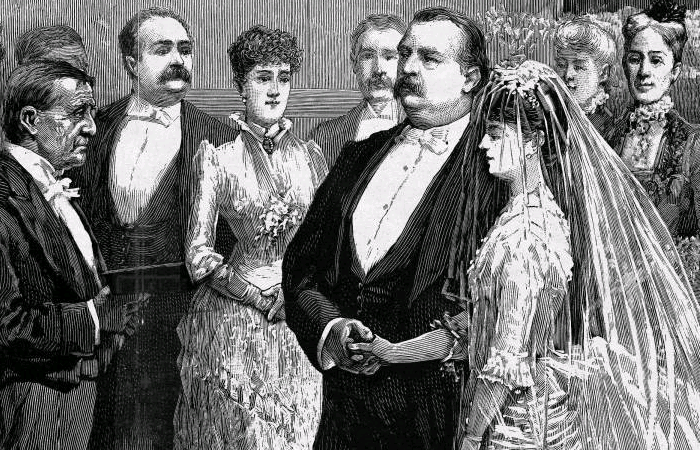
Two years after the election, the first presidential marriage to occur in the White House united Grover Cleveland (49) and Frances Folsom (22). Frances was the daughter of Cleveland’s old law partner Oscar Folsom. Cleveland was the executor of Oscar Folsom's estate and had supervised Frances' upbringing after her father's death. Cleveland had known Frances from babyhood and had helped to buy her first baby carriage. A regular visitor to the Folsom house, Cleveland had taken Frances toys. When Frances went off to college, her room was kept bright with flowers from “Uncle Cleve.” For his part, Cleveland confided to his sister that he was, “waiting for his wife to grow up.”

The American public was enchanted with the match and the marriage was a success. The Cleveland’s had five children and were happily married for some twenty two years.


My titles on Amazon  

My titles at Barnes & Noble


The best reading experience on your Android phone or tablet, iPad, iPhone, Mac, Windows 8 PC or tablet, BlackBerry, or Windows Phone.

Friday, November 16, 2012

The Union Spy Ring in Richmond: Black Spy in the Confederate White House


Elizabeth Van Lew

The White House of the Confederacy

Elizabeth Van Lew of Richmond, although from a good family, was an ardent Unionist who refused to leave town even as the Confederate government took up residence. Her continued devotion to the Union cause was considered just another of the eccentricities of the woman her neighbors came to call “Crazy Bet”. Van Lew began to accentuate her eccentricities. As she walked along the street, she mumbled and hummed to herself, head bent to one side, holding imaginary conversations. Her disguise served her well as she set up a wide reaching spy ring within the Confederate capital, and some say within the Confederate White House itself.


Van Lew began visiting Richmond’s Libby Prison, where Union POWs were imprisoned. As a humanitarian gesture, Van Lew brought food, medicine, and books to the prisoners. She came out with military information. Newly arrived Union prisoners secretly recounted the strength and dispositions of Confederate troops they had seen on their way from the front to Richmond. As the war progressed Van Lew was able to place fellow Union sympathizers within the Confederate War and Navy Departments, and regularly smuggled messages out of Richmond in hollow eggs. General Grant would later say of her efforts, “You have sent me the most valuable information received from Richmond during the war.”

Van Lew’s most daring purported accomplishment remains shrouded in mystery and involved insinuating one of her former servants, Mary Elizabeth Bowser (also known as Mary Jane Richards) into the Confederate White House. Bowser had been a slave of the Van Lew family, but Van Lew freed her and sent her North to be educated many years before the war. When Van Lew established her spy ring she asked Bowser to return and work with her for the Union. Van Lew obtained a position for Bowser as a servant in the Confederate White House through the recommendation of a "friend" who provided supplies to that household. Bowser reported conversations she overheard and the content of documents she was able to read while working in the house. Another Union spy, Thomas McNiven, noted that Bowser had a photographic memory and could report every word of the documents she saw. Stories about Bowser appeared as early as May 1900 in Richmond newspapers. In a 1910 interview with Van Lew’s niece, Bowser was revealed as being part of the spy ring. Jefferson Davis' wife, Varina, publicly denied that a black female spy could have infiltrated the Confederate White House and denied any knowledge of such a person as Mary Elizabeth Bowser. Bowser was inducted into the US Army Intelligence Hall of Fame at Fort Huachuca, Arizona, on 30 June 1995.

When the Union army captured Richmond in April 1865, Van Lew was the first person to raise the U.S. flag in the city. After the war she insisted, “I'm not a Yankee”, maintaining that she was only a good Southerner, holding to an old Virginia tradition of opposition to human bondage.


My titles on Amazon

My titles at Barnes & Noble


The best reading experience on your Android phone or tablet, iPad, iPhone, Mac, Windows 8 PC or tablet, BlackBerry, or Windows Phone.


Tuesday, November 13, 2012

John Quincy Marr: First Confederate Officer Killed in the Civil War


Fort Sumter fell on April 14, and on April 17 Virginia adopted an “Ordinance of Secession” in the form of a repeal of Virginia’s ratification of the U.S. Constitution, to take effect upon ratification by the vote of the people. This election took place on Thursday, May 23, 1861, and Virginia seceded from the Union.


Before dawn on Friday, May 24, Union troops invaded Virginia, seizing Alexandria and Arlington Heights across from Washington City. On Friday afternoon, miles away at Fox’s Mills, north of Fairfax Court House, seventeen year old Sally Summers was minding the afternoon recess in front of her schoolhouse when she saw a surrey coming down the road from the direction of Alexandria. The driver was her uncle, Amos Fox. As he passed he shouted, “You better dismiss your school right away and go home to your mother. The Union army is advancing!”

Three Virginia militia units (the Rappahannock Cavalry, the Prince William Cavalry, and the Warrenton Rifles) had taken up positions around the strategic village of Fairfax Courthouse. These units were still a part of the "Virginia Army," even though the secession of Virginia was ratified by a popular vote on May 23, 1861. Virginia’s forces were not transferred to the Confederacy until June 6, 1861.

Before dawn on June 1st, Lt. Charles Tompkins, 2nd U.S. Cavalry led a raid on Fairfax Courthouse. After charging through lines of the Virginians twice, the Union cavalry was finally driven off. In the morning, the body of Captain John Quincy Marr of the Warrenton Rifles was discovered. Marr had been hit by a spent round ball. He had a large bruise above his heart but his skin had not been penetrated.

Captain Marr's body arrived in Warrenton that evening and he was buried the next afternoon in the Warrenton Cemetery after a ceremony in the clerk's office yard before a large crowd of mourners. Marr became a Southern martyr.

Charles Henry Tompkins received the Congressional Medal of Honor for his actions at Fairfax Court House. His was the first action of a Union Army officer in the American Civil War for which a Congressional Medal of Honor was awarded, although it was not awarded until 1893. His citation reads: "Twice charged through the enemy's lines and, taking a carbine from an enlisted man, shot the enemy's captain."


My titles on Amazon

My titles at Barnes & Noble


The best reading experience on your Android phone or tablet, iPad, iPhone, Mac, Windows 8 PC or tablet, BlackBerry, or Windows Phone.


Tuesday, November 06, 2012

Sid Grauman and the celebrities of Hollywood


No single individual did more to create the Hollywood cult of celebrity than theatrical genius Sid Grauman.  As a youth, Grauman worked in the ramshackle towns of the Alaska Gold Rush as a paperboy.  Newspapers were scarce and expensive, costing up to one dollar each.  Grauman met a store owner who purchased one of his newspapers for $50. The store owner then charged admission to local miners to whom he read the paper aloud in his store. Grauman learned that people would pay handsomely to be entertained.

Grauman built a series of theaters that would define the “movie palace” of Hollywood’s Golden Era.  The Egyptian theater, built in 1922, was the setting for the first-ever Hollywood premiere, Robin Hood, starring Douglas Fairbanks, on Wednesday, October 18, 1922.  The exterior and interior walls of the theater contained Egyptian-style paintings and hieroglyphics. The four massive columns that mark the theatre's main entrance are 4+12 feet wide and rise to a height of  20 feet, the large courtyard in the front, complete with a fountain and palm trees, was specifically designed to host the theater’s famous red carpet ceremonies.


 Grauman built an even more magnificent theater in 1927 further up Hollywood Boulevard, the Chinese Theater. The Chinese Theater was modeled on a Mandarin palace. Not satisfied with the fusion of opulence and stardom, Grauman imbued the Chinese Theater with a mystic aura for millions of movie fans: it was Grauman’s brainchild to invite movie stars to place their hands and feet in the wet cement of the theater’s patio. The dried imprints became like holy relics to movie fans, the imprints also allowed fans to measure their own hands and feet against these relics of their saints.


The hand and feet prints of Marilyn Monroe are said to be the most popular relics.

My titles on Amazon

My titles at Barnes & Noble


The best reading experience on your Android phone or tablet, iPad, iPhone, Mac, Windows 8 PC or tablet, BlackBerry, or Windows Phone.

Sunday, September 02, 2012

Midnight Rising: John Brown’s Raid (Book Review)


By Tony Horowitz

A well written and informative book, but one which romanticizes and glorifies terrorism, for that was what John Brown was by the standards of his own day and by the standards of our own.

Brown, a religious fanatic, with a family history of mental illness, whom Horowitz acknowledges many of his close associates thought exhibited signs of insanity, saw himself as God’s instrument on earth. Brown was pledged to violence and declared, “The sins of this country can only be purged with blood.” Wherever Horowitz uses the word “insurgent” substitute “jihadist” and try to conjure up the same sympathy for Brown that Horowitz’s use of the milder term allows.

There is little to admire in Brown’s bloody career, which ranged from hacking five unarmed men to death in Kansas in 1856 to killing unarmed civilians at Harper’s Ferry in 1859 and trying to incite widespread murder and mayhem. Brown was disavowed in his own day by most in the North, including the Republican candidate for President, Abraham Lincoln. Despite Brown’s condemnation by the moderate elements of his own day, Horowitz, embraces the position of the most polarized abolitionists of 1859 in somehow seeing Brown as having performed a service to the nation by providing the “spark that caused the civil war.” The supposition being that only a bloody civil war that resulted in 600,000 deaths (as a percentage of population this would equate to some six million Americans today) could result in the abolition of slavery.

This supposition is wrong however. Another American slave society abolished slavery without firing a shot. The other great slave society of the late 19th century was Brazil. The Brazilian economy depended on slaves especially in mining, cotton production, and sugar cane production. More slaves were imported into Brazil over the course of three centuries than were imported into North America. By the late 19th century slavery was in decline. Slaveowners preferred to pay free immigrant labor from Europe low wages than to keep supporting entire slave communities from cradle to grave, since a significant portion of those communities (the sick, disabled, very young, and very old) were non-productive. By 1871, the sons of all existing slaves were freed. In 1885, all slaves aged over 60 years were freed. Slavery was legally ended nationwide on May 13, 1888, with the government compensating slaveowners for each slave freed. A mere twenty three years after the bloody American Civil War Brazil ended slavery peacefully, perhaps because it did not have fanatics like John Brown to foment fear and violence.


The last death agonies of the Confederacy captured in pictures.