Showing posts with label Gilded Age. Show all posts

Tuesday, January 08, 2019

George Pullman's Worker's Paradise


The model town of Pullman, located on the far south side of Chicago, was built in the 1880s on land controlled by the Pullman Palace Car Company (think railroads and the luxurious Pullman cars).  The town was the brainchild of George W. Pullman, who thought he could avoid strikes, attract the most skilled labor, and achieve greater productivity by providing workers with a superior living environment. 


The residents weren’t as enthusiastic, and complained that rents, and prices in the company owned stores, were too high.  With the Depression of 1892, wages dropped, but rents and food prices stayed the same.  The bloody nationwide Pullman strike of 1894 resulted.  During the course of the strike, 30 strikers were killed and 57 were wounded before the strike was broken.


In 1898, the Illinois Supreme Court ruled that the company’s charter did not include the right to run a town.  Pullman became just another residential neighborhood until the area was granted landmark status, and the Historic Pullman Foundation set to work restoring it in the 1970s.


The Pullman Arcade Building, seen here in 1894 during the strike,  is being guarded by the Illinois National Guard.  The Arcade Building contained a 500-seat theatre, a post office, library, the Pullman Trust and Savings Bank, the town management offices as well as office and storefront spaces that were rented to private businesses.  


Video: The Gilded Age and Revolution


We think we know the Victorians, but do we? The same passions, strengths and weaknesses that exist now, existed then, but people organized themselves very differently.


Saturday, September 01, 2018

The Gilded Age (1870-1900) and Revolution


The Gilded Age

There was a mandate for change in the Gilded Age, but no agreement on what that change should be among the many groups that made up American society.
The upper industrial class engineered a wrenching economic transformation, accumulated staggering fortunes, and pursued notorious private lives, upholding a set of values at odds with the middle class, farmers, and workers. Even among themselves the upper industrial class disagreed how best to live their lives and secure their future. Andrew Carnegie and John D. Rockefeller, among the most successful, were, with their austere lifestyles and doctrines of philanthropy, revolutionaries to other members of the upper industrial class. 


The middle class was split between old style Radicals such as Albion Tourgee with notions of color blind meritocracy and more cautious middle class reformers such as the Progressives who sought to avoid societal turmoil and remake workers, immigrants and the industrial upper class in their own image.
Farmers simultaneously pursued the agrarian myth of the yeoman farmer, while living the life of the rural small businessman.
Labor divided between those seeking a re-structuring of society and those primarily concerned with wages and working conditions.
Sectional and racial issues unresolved from the time of the Civil War continued to divide.
Women increasingly questioned prescribed gender roles.

No group could unilaterally impose its will. Instead, each group usually had to make alliances, some of them strange and uncomfortable, and win over at least some of the enemy in order to achieve its goals. For example, by the end of the century, many women suffragists argued that Anglo-Saxon women’s votes, would serve as bulwark against the influence of foreign and black votes.
Then, as now, the very fragmentation of America precluded revolution or the emergence of a successful radical opposition.


General George S. Patton once said, “Compared to war, all other forms of human endeavor shrink to insignificance.” Here are four stories about the history of the world IF wars we know about happened differently or IF wars that never happened actually took place.


Friday, February 22, 2013

Divorce in Victorian Times

Horace Greeley

Laws concerning divorce varied widely among the states throughout much of American history. In New England, where the Puritans had defined marriage as a civil contract rather than a religious sacrament, secular law had provided for divorce as early as the 17th century. Like any other contract, the marriage bond could be broken when either of the contracting parties failed to meet the obligations it imposed. Adultery, impotence, desertion, or conviction for serious crimes, were all grounds for divorce. Additionally, wives could obtain a divorce on the grounds of non-support.


In most states in the early 19th century, an act of the legislature was required to end a marriage. As the century progressed divorce laws became more liberal. During the 1850s, Indiana was widely condemned for its liberal ways. A couple in Indiana could obtain a divorce on any grounds that a judge ruled “proper”. Indiana judges were far more permissive than the New York City judge who in 1861 refused to grant a divorce to a wife whose husband had beaten her unconscious in an argument over letting the family dog sleep on the bed. The judge advised the woman that “one or two acts of cruel treatment” were not proper grounds for divorce. Indiana’s liberal stance on divorce attracted a flood of applicants from other states. The influential newspaper editor and future presidential nominee, Horace Greeley denounced Indiana as “the paradise of free-lovers” whose example would soon lead to “a general profligacy and corruption such as this country has never known.”


Thursday, February 21, 2013

Free Love in Victorian Times


Victoria Woodhull
"High priestess of Free Love"

In the state of New York, the Oneida Community, founded in 1848, described marriage as, “contrary to natural liberty....a cruel and oppressive method of uniting the sexes.” This group practiced a form of community marriage where each woman was married to every man and each man to every woman. The Oneida Community “[rejects] conventional marriage both as a form of legalism from which Christians should be free and as a selfish institution in which men exerted rights of ownership over women”. The movement’s founder, John Humphrey Noyes coined the term “free love” and found scriptural justification for the concept: “In the resurrection they neither marry nor are given in marriage, but are like the angels in heaven” (Matt. 22:30). The Oneida Community lived together as a single large group and shared parental responsibilities.

The concept of “free love” blossomed outside of the Oneida Community. Victoria Woodhull, the first woman to run for president (1872), was called “the high priestess of free love”. In 1871, Woodhull wrote:

“Yes, I am a Free Lover. I have an inalienable, constitutional and natural right to love whom I may, to love as long or as short a period as I can; to change that love every day if I please, and with that right neither you nor any law you can frame have any right to interfere. And I have the further right to demand a free and unrestricted exercise of that right, and it is your duty not only to accord it, but, as a community, to see that I am protected in it. I trust that I am fully understood, for I mean just that, and nothing less!”

Woodhull received fewer than sixteen thousand votes nationwide. Most Americans rejected alternative forms of marriage and pressured young people to marry conventionally. A man's credit rating depended in part on whether or not he was conventionally married and had children.


My titles on Amazon   My titles at Barnes & Noble


The best reading experience on your Android phone or tablet, iPad, iPhone, Mac, Windows 8 PC or tablet, BlackBerry, or Windows Phone.

Monday, February 18, 2013

The Social Purity Movement and Family Planning


By the 1870s, couples in all classes were choosing to limit and plan family size “by a variety of methods within a culture of abstinence”. “Considerate” husbands, who did not insist on intercourse, were admired, not least because of the high mortality rate among pregnant women. It was perhaps a good thing that husbands had decided to privately abstain from sex, since by the mid 1870’s the United States government had invaded every bedroom in the nation. In the 1870’s a “social purity movement”, spurred on by evangelical Protestant moral reformers launched a crusade against vice, including contraception, which was considered to “lead to lewd, immoral behavior and promote promiscuity”. It is not surprising that such a movement arose. The industrialization that swept America during and after the Civil War ushered in morality problems such as widespread prostitution. As urbanization flourished so did prostitution. The majority of prostitutes were young, illiterate, and poor. Higher wages for less work appealed to many young women. With little in the way of birth control, frequent pregnancies occurred among prostitutes. Since being pregnant would put them out of work, abortion became the alternative for the tens of thousands of prostitutes in America’s teeming cities. The moral laxness sweeping much of America began to impact public opinion. Social purity advocates proclaimed, “Social crimes like infanticide, that were once placed on the same level as murder, are now not only looked upon with complacency... but are defended on principle by certain theorists.”


The social purity movement successfully pressured Congress into passing the Comstock Act (named after the movement’s leader Anthony Comstock) in 1873. The Comstock Act was a federal law which, among other things, prohibited mailing, “any article or thing designed or intended for the prevention of conception or procuring of abortion”, as well as any form of contraceptive information. Twenty four states passed similar state laws (collectively known as the Comstock Laws), sometimes extending the federal law by outlawing the use of contraceptives, as well as their distribution. The most restrictive state laws of all were in Connecticut. Married couples could be arrested for using birth control in the privacy of their own bedrooms, and subjected to a one-year prison sentence. As late as 1960, thirty states had statutes on the books (inspired by the Comstock Laws) prohibiting or restricting the sale and advertisement of contraceptive devices.

My titles on Amazon   My titles at Barnes & Noble


The best reading experience on your Android phone or tablet, iPad, iPhone, Mac, Windows 8 PC or tablet, BlackBerry, or Windows Phone.

Wednesday, January 23, 2013

Love, Sex and Marriage in Victorian America


Queen Victoria reigned over the British Empire, the largest and most diverse empire the world has ever known, from 1837-1901, and gave her name to the age. Among other things the Victorian Age has become known for its sexual prudery. In many things, including social customs, the United States mirrored what was happening across the sea in Britain. Women were allotted a subsidiary role, with patience and self-sacrifice the prime feminine virtues. Motherhood was idealized, alongside virginal innocence. The ideal of purity in sexual behavior became sacrosanct, at least in public.


No one better exemplifies the popular notion of the buttoned up old maid Victorian American prude than purity crusader Carry Nation. Carry Nation is best remembered for crusading against alcohol, but she was also enthusiastically against tobacco, politicians, and sex. She lectured young couples on the evils of buggy riding, she stopped women on the street to warn them against the dangers of seduction, and she wrote a newspaper column whose main theme was the evil of self abuse. After two disastrous marriages, in which her husbands resented her overzealous Christianity and she resented their overzealous embraces, Carry Nation concluded that men were, “…nicotine soaked, beer-besmeared, whiskey-greased, red-eyed devils” and “two-legged animated whiskey flasks.”

  People like Carry Nation have given us a view of Victorian America.  We think we know the Victorians, but do we? The same passions, strengths and weaknesses that exist now, existed then, but people organized themselves very differently.   Read more in:  Love, Sex and Marriage in Victorian America    

  My titles on Amazon   My titles at Barnes & Noble


The best reading experience on your Android phone or tablet, iPad, iPhone, Mac, Windows 8 PC or tablet, BlackBerry, or Windows Phone.

Sunday, January 13, 2013

Grover Cleveland: The Philandering President


Victorian America had its share of philandering politicians, including Grover Cleveland the 22nd and 24th President of the United States (the only U.S. president to serve two non-consecutive terms 1885-1889 and 1893-1897).

During the election of 1884, Cleveland’s Republican opponents discovered reports that Cleveland had fathered an illegitimate son while he was a lawyer in Buffalo, and chanted “Ma, Ma, where's my Pa?” in derision. Cleveland admitted to paying child support in 1874 to Maria Halpin, for the maintenance of her son Oscar Folsom Cleveland. Maria Halpin had been involved with several men while an intimate of Cleveland’s, including Cleveland's law partner, Oscar Folsom, for whom the child was also named. Grover Cleveland did not know who the father was, but assumed responsibility.

Despite the scandal, Cleveland won the presidential election of 1884. His backers turned the Republican attack phrase, “Ma, Ma, where’s my Pa?” into a victory slogan, “Ma, Ma, where’s my Pa? Gone to the White House Ha! Ha! Ha!”

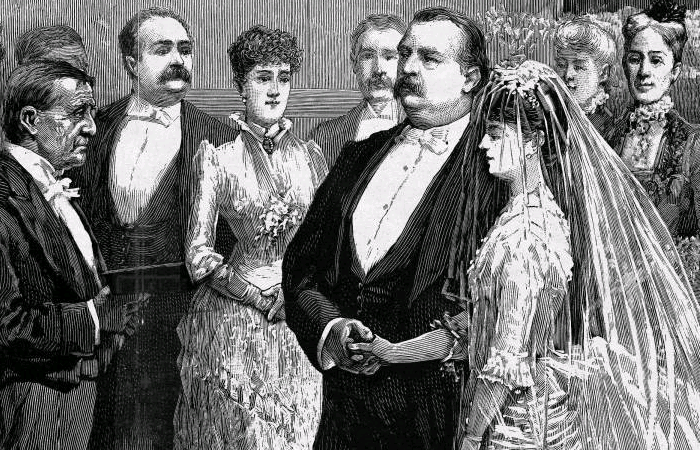
Two years after the election, the first presidential marriage to occur in the White House united Grover Cleveland (49) and Frances Folsom (22). Frances was the daughter of Cleveland’s old law partner Oscar Folsom. Cleveland was the executor of Oscar Folsom's estate and had supervised Frances' upbringing after her father's death. Cleveland had known Frances from babyhood and had helped to buy her first baby carriage. A regular visitor to the Folsom house, Cleveland had taken Frances toys. When Frances went off to college, her room was kept bright with flowers from “Uncle Cleve.” For his part, Cleveland confided to his sister that he was, “waiting for his wife to grow up.”

The American public was enchanted with the match and the marriage was a success. The Cleveland’s had five children and were happily married for some twenty two years.


My titles on Amazon  

My titles at Barnes & Noble


The best reading experience on your Android phone or tablet, iPad, iPhone, Mac, Windows 8 PC or tablet, BlackBerry, or Windows Phone.

Friday, June 26, 2009

The Populists, the Progressives, and Revolution in America

Link to:
There was a mandate for change in the Gilded Age, but no agreement on what that change should be among the divergent groups that made up American society. (1) The upper industrial class engineered a wrenching economic transformation, accumulated staggering fortunes, and pursued notorious private lives, upholding a set of values at odds with the middle class, farmers, and workers. Even among themselves the upper industrial class disagreed how best to live their lives and secure their future. Andrew Carnegie and John D. Rockefeller, among the most successful, were, with their austere lifestyles and doctrines of philanthropy, revolutionaries to other members of the upper industrial class; (2) the middle class was split between old style Radicals such as Albion Tourgee with notions of color blind meritocracy and more cautious middle class reformers such as the Progressives who sought to avoid societal turmoil and remake workers, immigrants and the industrial upper class in their own image; (3) the agrarian class simultaneously pursued the agrarian myth of the yeoman farmer, while living the life of the rural small businessman; (4) labor divided between those seeking a re-structuring of society and those primarily concerned with wages and working conditions; (5) sectional and racial issues unresolved from the time of the Civil War continued to divide; (6) women increasingly questioned prescribed gender roles.

No group could unilaterally impose its will. Instead, each group usually had to make alliances, some of them strange and uncomfortable, and win over at least some of the enemy in order to achieve its goals. For example, by the end of the century, many women suffragists argued that Anglo-Saxon women’s votes, would serve as bulwark against the influence of foreign and black votes. Then, as now, the very fragmentation of America precluded revolution or the emergence of a successful radical opposition.


My titles on Amazon

My titles at Barnes & Noble


The best reading experience on your Android phone or tablet, iPad, iPhone, Mac, Windows 8 PC or tablet, BlackBerry, or Windows Phone.

Friday, May 08, 2009

Teddy Roosevelt and the Progressives

“Too much cannot be said against the men of wealth who sacrifice everything to getting wealth. There is not in the world a more ignoble character than the mere money-getting American, insensible to every duty, regardless of every principle, bent only on amassing a fortune, and putting his fortune to only the basest uses….”

Page 96: A Fierce Discontent: The Rise and Fall of the Progressive Movement in America by Michael McGerr. Oxford University Press, 2003

Link to Amazon.com:


My titles on Amazon

My titles at Barnes & Noble


The best reading experience on your Android phone or tablet, iPad, iPhone, Mac, Windows 8 PC or tablet, BlackBerry, or Windows Phone.

Monday, March 30, 2009

Review: The Populist Moment by Lawrence Goodwyn.

The Populist Moment by Lawrence Goodwyn.


Goodwyn’s 1978 book, published in the post-Vietnam/post-Watergate era, is heavily laden with Marxist analysis and argues, “The agrarian revolt demonstrated how intimidated people could create for themselves the psychological space to dare to aspire grandly….” Consensus did not exist, the meaning of the agrarian revolt was its cultural assertion as a people’s movement of mass democratic aspiration against entrenched interests to which “the plain people” were diametrically opposed.(Goodwyn, 295) The Populists were attempting to bring the corporate state under democratic control.

Goodwyn argues that how money was created, and on what basis it circulated, defined in critical ways the relationships of farmers, urban workers, and commercial participants in the emerging industrial state. The government’s reliance on the gold standard meant deflation, which translated into the long postwar fall of farm prices. (Goodwyn, 24) High interest rates benefited only creditors and moneylenders. Furnishing merchants, for example, demanded that their debtors plant one certain cash crop, cotton. “No cotton, no credit”. If the farmer failed to “pay out” he still owed the merchant a remaining balance for the supplies furnished on credit during the year. Such was the crop lien system. The crop lien system became for millions of Southerners, little more than slavery. (Goodwyn 21-25) To the nation’s farmers, contraction of the money supply, caused by business’ insistence on “hard currency”, was a “mass tragedy”. Farmers had three choices, they could put their hopes on more efficient farming, they could concentrate their energies on economic cooperatives, or they could organize and secure changes in the regulations that governed the relations between different classes of citizens. (Goodwyn, 109) When economic cooperatives failed, farmers turned to politics. Goodwyn argues that business and financial entrepreneurs had achieved effective control of a restructured American party system in both the North and the South and farmers had little choice but to turn to politics if they were to “…(achieve) a civic culture grounded in generous social relations and in a celebration of the vitality of human cooperation and the diversity of human aspiration itself ” (Goodwyn, 292) The Populist Movement was the product of an insurgent culture that grew out of the gradual raising of class consciousness as farmers struggled against bankers and financiers. (Goodwyn, 61)

Goodwyn argues that Populism was a insurgent democratic movement who’s time had not yet come. “What could a Protestant, Anglo-Saxon Alliance organizer say to the largely Catholic, largely immigrant urban working classes of the North….In 1892, what (Populism) lacked was a social theory of sufficient breadth to appeal to all….”(Goodwyn, 177) The agrarian movement achieved the politicization of masses of people, however it was still unable to break the bonds of inherited political habits. Populist attempts to construct a national farmer-labor coalition came before the fledgling American labor movement was internally prepared for mass insurgent politics. (Goodwyn, 297) Goodwyn argues, “A consensus thus came to be silently ratified: reform politics need not concern itself with structural alteration of the economic customs of the society. This conclusion, of course, had the effect of removing from mainstream reform politics the idea of people in an industrial society gaining significant degrees of autonomy in the structure of their own lives.” (Goodwyn, 284)

My titles on Amazon

My titles at Barnes & Noble


The best reading experience on your Android phone or tablet, iPad, iPhone, Mac, Windows 8 PC or tablet, BlackBerry, or Windows Phone.

The Populists and the Progressives

Richard Hofstadter, The Age of Reform, New York: Random House, 1955

Richard Hofstadter examines the great American reform movements from 1890 - 1940 (the Populist Movement, Progressivism, and the New Deal) and asks: (1) What were the ideas of the participants? and (2) How did Populism and Progressivism differ from the New Deal?

The ideology of the Populist movement reflected the American agrarian myth (the virtues of the independent yeoman farmer). Urbanization and industrialization, coupled with a virtual “immigrant invasion” gave rise to the notion of an innocent and victimized rural population. Populism insisted that the federal government had some responsibility for the common welfare, “The people versus the interests, the public versus the plutocrats, the toiling multitude versus the money power….” (Hofstadter, 65) Failure at the ballot box (the defeat of the third party bid to capture the White House) led rural interests to pursue modern methods of pressure politics and lobbying within the framework of the existing party system where they were largely successful in accomplishing their economic goals. (Hofstadter, 95)

The Progressive movement was urban, middleclass and nationwide. Progressives (like the Populists) were native born Protestants. Corporations, labor unions, and political machines (which organized incoming immigrants) were aggregating and presenting unorganized citizens the prospect that they would be unable to resist the new forces. The Progressive movement was “the complaint of the unorganized against the consequences of organization.” (Hofstadter, 216) Progressivism tried to restore a type of economic individualism and political democracy that was believed to have existed earlier in America and to have been destroyed by the great corporations and the corrupt political machines.(Hofstadter, 5)

Hofstadter argues that Populism and Progressivism were driven by moral absolutes arising from the Protestant evangelical tradition. He suggests that to some degree both the Populists and Progressives were deluded by these ideological motivations which did not align with either their true economic interests or the necessity for new organizational modes required by a more advanced technological society. He argues for example that, “The prosperity of the commercial farmers was achieved not only in spite of but in good part because of the rise of American industry and the American city”. (Hofstadter, 110) Hofstadter argues that Progressives were trying to keep the benefits of the emerging organization of life and yet to retain the scheme of individualistic values that this organization was destroying. (Hofstadter, 217) Hofstadter’s central argument is that modern organizational necessities trumped ideology, “In their search for mechanical guarantees of continued popular control the reformers were trying to do something altogether impossible…to institutionalize a mood.” (Hofstadter, 266) Neither the Populists nor the Progressives offered an effective countervailing organizational structure for the realization of their reform goals. The New Deal, which was above all else pragmatic and boldly experimental, offered such an alternative organizational structure, pro-active big government.

How effective is Hofstadter’s argument? His deconstruction of the “soft” and “hard” motives of the Reformers is illuminating. He basically suggests that there was no inherent conflict between the new emerging organizations and the Protestant farmers and middle class who made up the Reform movements. Farmers’ economic interest benefited from the advent of urbanization and industrialization. In absolute terms, the native middle class also enjoyed material benefits. Hofstadter’s view is perhaps too materialistic. Progressives at the time argued that the nation was enjoying prosperity but losing its soul. “Anything that makes the organization greater than the man…is against all the principles of progress.” (Hofstadter, 226) Hofstadter appears to have little patience with intangibles and projects a firm believe in the values of pragmatism. To dismiss intangibles, however, is to deny the importance of irrational motives in history. There are, however, numerous historical examples of people and nations acting in ways inconsistent with their apparent self interest (e.g. the continuation of the slaughter in World War I long after the point where any conceivable goal could justify the cost).

Hofstadter’s concentration on the “critical path” of history, determined by emergent technical and social forces, is a powerful analytical technique. Basically his argument runs: The growth of big organizations was inevitable in a more complex technical and social environment. “Soft motives”, like the myth of the yeoman farmer, always lag behind the emerging necessities of modernity. Such old myths may produce social anxieties but may also have uses in softening transitions between historical periods (e.g. reform movements). “The rise of big business may have been inevitable, but if so it was salutary that it should have taken place in a climate of opinion that threw it intermittently on the defensive”. (Hofstadter, 255)

Hofstadter’s book is a product of the 1950s and makes virtually no mention of either women or African Americans which will be jarring for the modern reader.

The Gilded Age and Revolution


Love, Sex and Marriage in Victorian America


My titles on Amazon

My titles at Barnes & Noble


The best reading experience on your Android phone or tablet, iPad, iPhone, Mac, Windows 8 PC or tablet, BlackBerry, or Windows Phone.