Friday, April 08, 2016

The First Woman to Win The Congressional Medal of Honor


The first woman POW was taken in the Civil War. Union army contract surgeon Dr. Mary E. Walker was captured on April 10, 1864. She was imprisoned in the military prison in Richmond, Virginia known as "Castle Thunder". She was released on August 12, 1864, in a prisoner exchange.

Dr. Walker was awarded the Medal of Honor for her service as a surgeon during the Civil War, “without regard to her own health and safety”. She is the only woman to have received the Medal of Honor. When the criteria for awarding the medal changed in 1917, Dr. Walker’s medal was rescinded along with 900 others. In 1977 the Army Board of Corrections reviewed the case and reversed the 1917 decision, restoring the Medal of Honor to Dr. Walker.
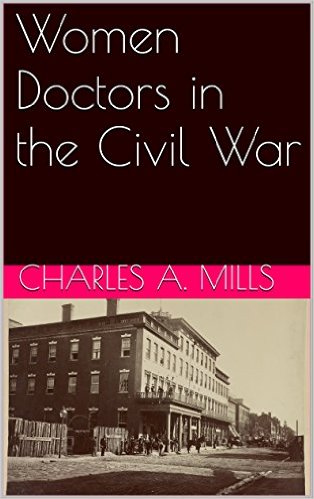


A quick look at women doctors and medicine in the Civil War for the general reader. Technologically, the American Civil War was the first “modern” war, but medically it still had its roots in the Middle Ages. In both the North and the South, thousands of women served as nurses to help wounded and suffering soldiers and civilians. A few women served as doctors, a remarkable feat in an era when sex discrimination prevented women from pursuing medical education, and those few who did were often obstructed by their male colleagues at every turn.


Slave Marriage Laws Before the Civil War


In pre-Civil War America, slave marriages were not recognized in the state codes. No state legislature ever considered encroaching upon a master’s property rights by legalizing slave marriage. Marriage was, “voluntary on the part of the slaves and permissive on that of the master.”

Slave marriages were regulated by whatever laws the owners saw fit to enforce. Some masters arbitrarily assigned husbands to women who had reached the “breeding age”. Ordinarily slaves picked their own mates, but were required to ask the master for permission to marry. Most owners refused to allow slaves to marry away from home. Men who married away from home were frequently absent and thus exposed “to temptations”.

Having obtained the masters consent, the couple might begin living together without further formality, or their masters might pronounce vows. Ceremonies conducted by slave preachers or white clergymen, were not uncommon even for field hands and were customary for the domestic servants. No slave marriage, however, was ever safe from the caprice of the master who could end the marriage by selling one or both of the partners. Thus, a slave preacher in Kentucky united couples in wedlock, “until death or distance do you part.”


A brief look at love, sex, and marriage in the Civil War. The book covers courtship, marriage, birth control and pregnancy, divorce, slavery and the impact of the war on social customs.


The Civil War Wedding, an entertaining look at the customs and superstitions of weddings during the Civil War era.


Friday, April 01, 2016

The Strange Case of Montgomery Meigs and Robert E. Lee


Brigadier General Montgomery C. Meigs (above), commander of the garrison at Arlington House and Quartermaster General of the Union Army, who may have had a grudge against Robert E. Lee, was tasked with finding additional burial grounds for battle casualties.  Meigs and Lee had served together many years earlier as military engineers on the Mississippi River.  Lee was a 1st Lieutenant and Meigs his subordinate, a 2nd Lieutenant.  Did Meigs bear Lee a personal grudge?  Some historians think so, or perhaps he was just embittered by the war itself, or by Lee’s defection from the Union army.  Meigs wrote to the Secretary of War stating that “the grounds about the mansion are admirably suited to such a use.” Meigs reported his “grim satisfaction” of ordering twenty six Union dead to be buried near Mrs. Lee’s rose garden in June, 1864. 

Meigs had graves dug right up to the entrance to the house.  This was malicious.  Meigs intended to prevent the Lee family from ever again inhabiting the house.  More than 16,000 Union soldiers were buried on the estate’s grounds. Ironically, Meigs’ own son was sent to Arlington Cemetery for burial.                                                                             

Neither Robert E. Lee nor his wife ever set foot in Arlington House again. In 1882, the U.S. Supreme Court returned the property to the Lee family, stating that it had been confiscated without due process. General Lee's son sold the house and land to the government for its’ fair market value. 
Read more: Historic Cemeteries of Northern Virginia


A quick look at women doctors and medicine in the Civil War for the general reader. Technologically, the American Civil War was the first “modern” war, but medically it still had its roots in the Middle Ages. In both the North and the South, thousands of women served as nurses to help wounded and suffering soldiers and civilians. A few women served as doctors, a remarkable feat in an era when sex discrimination prevented women from pursuing medical education, and those few who did were often obstructed by their male colleagues at every turn.


Friday, March 25, 2016

Who Were the Child Soldiers of the Confederacy?


Sergeant William T. Biedler

Sergeant William T. Biedler, 16 years old, of Company C, Mosby's Virginia Cavalry Regiment is pictured above.   Many of Mosby’s soldiers were too young to join the regular army.  Mosby favored these young troopers. “They haven’t sense enough to know danger when they see it, and will fight anything I tell them to,” he once said.

Charles Biedler was born November 9, 1847, and in his teens served with Mosby's Rangers. At one time, while guarding a squad of Federal prisoners in a barn, he, singlehandedly, foiled their attempted escape. One of the prisoners, whose life Biedler spared, presented his youthful captor with a golden trinket as a mark of gratitude.  Biedlar had this gift fashioned into his wife's wedding ring. Charles E. Biedler died in Baltimore, Md., on October 11, 1926.


Women Doctors in the Civil War

In both the North and the South, thousands of women served as nurses to help wounded and suffering soldiers and civilians. A few women served as doctors, a remarkable feat in an era when sex discrimination prevented women from pursuing medical education, and those few who did were often obstructed by their male colleagues at every turn.


The 1865 Fall of Richmond in Pictures

The last death agonies of the Confederacy captured in pictures.

Gifts for Dog Lovers


Saturday, March 12, 2016

Disputed American Elections

In virtually every American presidential election, candidates vilify and demonize their opponents. The meme in the last several elections has been "Hitler", with everyone from  George W. Bush and Barack Obama to Hillary ("Hitlery") Clinton and Donald Trump being compared to the evil German dictator.

Historically, American presidential campaigns have always been messy, loud, and controversial. Here are some of the worst.


Saturday, February 27, 2016

Custer's Trials: A Life on the Frontier of a New America - Book Review


    Whatever else George Armstrong Custer may or may not have been, even in the twenty-first century, he remains the great lightning rod of American history.  For almost one hundred and fifty years, Custer has been a Rorschach test of American social and personal values.  Since his death along the bluffs overlooking the Little Bighorn River, in Montana, on June 25, 1876, over five hundred books have been written about the life and career of George Armstrong Custer, this book ranks among the worst.

     To paraphrase Samuel Johnson, the book is both good and original. Unfortunately, the parts that are good are not original, and the parts that are original are not good.  The good parts involve the author’s heavy use of secondary sources such as the writings of Robert Utley, and James Donovan when actually talking about Custer’s career.  The original parts, including the author’s peculiar decision to virtually ignore the Battle of the Little Big Horn while spending page after page on Custer’s finances, are very bad indeed.

     The author meanders tediously through 19th century American politics, finance, and racial affairs, writing in a self- indulgent, turgid academic style.  Stiles can simply not forgive Custer, his wife Elizabeth, or the people of 19th century America, for being, well…19th century Americans, living in the 19th century and having 19th century attitudes toward race, feminism, sexuality, and nationalism.  These people should obviously have had the foresight to have been born in the enlightened 21st century.

     If you like your history with heavy, self-righteous lashings of 21st century political correctness, you will love this book.  If not, you may wish to spare yourself this pompous lecturing.


Tuesday, February 02, 2016

Love, Sex and Marriage in Victorian Times

Queen Victoria reigned over the British Empire, the largest and most diverse empire the world has ever known, from 1837-1901, and gave her name to the age. Among other things the Victorian Age has become known for its sexual prudery. In many things, including social customs, the United States mirrored what was happening across the sea in Britain. Women were allotted a subsidiary role, with patience and self-sacrifice the prime feminine virtues. Motherhood was idealized, alongside virginal innocence. The ideal of purity in sexual behavior became sacrosanct, at least in public


We think we know the Victorians, but do we? The same passions, strengths and weaknesses that exist now, existed then, but people organized themselves very differently.

Monday, January 18, 2016

The Pentagon in 1861

Fort Runyon, named after Brig. Gen. Theodore Runyon, was located astride the important junction of the Washington Alexandria and Columbia Turnpikes, a half-mile south of the Long Bridge. The fort was built in July 1861 on the land of a Washington building contractor.  The largest fort in the defenses of Washington, it covered 12 acres and had a perimeter of 1,484 yards. Construction began on May 24, 1861 and was completed in seven weeks. Fort Albany was built on the high ground to protect the rear of Fort Runyon .  Fort Runyon was a pentagonal earth and timber fort, and was approximately the same size, and shape as the modern day Pentagon (built from 1941-1943).  Interestingly, the Pentagon now stands on almost the exact location of Fort Runyon.  A history marker now identifies where the fort once stood.  


A quick look at women doctors and medicine in the Civil War for the general reader. Technologically, the American Civil War was the first “modern” war, but medically it still had its roots in the Middle Ages. In both the North and the South, thousands of women served as nurses to help wounded and suffering soldiers and civilians. A few women served as doctors, a remarkable feat in an era when sex discrimination prevented women from pursuing medical education, and those few who did were often obstructed by their male colleagues at every turn.

Tuesday, December 08, 2015

Liberty Is Not Anarchy


U.S. Has History of Banning Dangerous Immigrants

     In the early part of the 20th century an increasing number of Americans grew concerned about violent immigrants from Eastern Europe who harbored messianic beliefs about anarchism and communism.  This fear was inflamed when an anarchist (Leon Frank Czolgosz, a home grown terrorist whose parents had immigrated to Ohio) assassinated President William McKinley in 1901.
     After World War I, with a devastated Europe suffering economic and social upheaval, hundreds of thousands of immigrants from Eastern Europe headed for America.  It is said that there were over 150,000 anarchists and communists in the United States by 1919 (which represented only 0.1% of the overall population, a small but dangerous minority).


     A series of bomb explosions in 1919, including a failed attempt to blow up the Attorney General, A. Mitchell Palmer, lead to a vigorous campaign against the communists. On New Year’s Day, 1920, over 6,000 people were arrested and put in prison.  In 1921, Congress passed the Emergency Immigration Act of 1921 which severely restricted immigration (new immigrants admitted fell from 805,000 in 1920 to 309,000 in 1921-22).  The 1921 act was made even tougher by the Immigration Act of 1924.  The purpose of this act was “to preserve the ideal of American homogeneity,” and, among other things, outright banned the immigration of Arabs.

     These tough immigration acts lasted until 1965 when they were replaced during the administration of Lyndon B. Johnson.


A brief look at the often overlooked stories of American history from colonial times to modern times, stories such as, the original Emancipation Proclamations, the plot to kill Martha Washington, terrorism in the Civil War, America’s plan to invade Canada in 1930, a planned coup against the president, and many others hidden tales.

Monday, November 30, 2015

George Washington and Billy Lee


George Washington bought William “Billy” Lee, his brother Frank and two other slaves in 1768.  Billy Lee was eighteen.  Frank became the butler at Mount Vernon, while Billy became Washington’s valet.  Billy also became the keeper of Washington’s pack of hunting dogs. 

Fox hunting was an important part of the social life of Virginia’s gentry, and Billy Lee distinguished himself as a huntsman at Washington’s side.  An eyewitness described Lee during a hunt, “Will, the huntsman, better known in Revolutionary lore as Billy, rode a horse called Chinkling, a surprising leaper, and made very much like its rider, low, but sturdy, and of great bone and muscle. Will had but one order, which was to keep with the hounds; and, mounted on Chinkling ... this fearless horseman would rush, at full speed, through brake or tangled wood, in a style at which modern huntsmen would stand aghast.” 


Washington took Billy Lee to war with him, where he served at Washington’s side for eight years.  After the war, between 1785-1789, Lee injured both of his knees and found himself back at Mount Vernon.  William Lee was freed under the terms of Washington’s will for, “his faithful services during the Revolutionary War”, and received a substantial pension for the remainder of his life and the option of remaining at Mount Vernon.  Lee lived on at Mount Vernon until his death in 1828.


Who were the slaves of the Founding Fathers? What do their individual stories tell us about the Founding Fathers as men?

Lincoln's Flying Spies

War presented special problems for the world of ladies’ fashion in the Confederacy, as is best described in the words of General James Longstreet:

“While we were longing for the (reconnaissance) balloons that poverty denied us, a genius arose... and suggested we.... gather silk dresses and make a balloon. It was done, and we soon had a great patchwork ship.... One day it was on a steamer down on the James River, when the tide went out and left the vessel and balloon high and dry on a bar. The Federals gathered it in, and with it the last silk dresses in the Confederacy.”


A quick look at women doctors and medicine in the Civil War for the general reader. Technologically, the American Civil War was the first “modern” war, but medically it still had its roots in the Middle Ages. In both the North and the South, thousands of women served as nurses to help wounded and suffering soldiers and civilians. A few women served as doctors, a remarkable feat in an era when sex discrimination prevented women from pursuing medical education, and those few who did were often obstructed by their male colleagues at every turn.


Cemetery Iconography

     Matters of life and death converge at a cemetery.  In death, the everyday distinctions of race, class and religion disappear.  Cemeteries are where the rich and poor, the young and the old, the famous and the not-so-famous come together in the end.
     Those who conceived the idea of the modern cemetery anticipated the movement for public parks.  Cemeteries provided the public with beautiful outdoor gathering spaces during a time when parks were scarce. Out of the movement to beautify cemeteries arose a custom of gathering in these new public spaces. Families picnicked near gravesites, and children played there. Somewhere along the way, this practice fell by the wayside.  The appreciation of cemeteries has made a comeback in the digital age.  Many genealogists have been using the Internet and GPS systems to locate the graves of long lost ancestors.  This renewed interest in cemeteries has spread to an interest in photographing tombstones, the growth of in-depth historical research, and even cemetery tourism.

     Historic cemeteries are a treasure trove of art, biography and philosophy, one’s last chance to shout out to posterity “This is who I was, this is what was important to me”.  Art, symbols and inscriptions are called upon to succinctly capture the essence of life in a beautiful and meaningful way.


Friday, November 20, 2015

The Beast of Gum Hill


     A Bristol man recently claimed that he and a hunting companion encountered a Bigfoot type beast near Gum Hill in Washington County.  The two came across a large figure sitting on a rock.  As the men approached, the figure rose, whistled and made other noise and then ran off.  The witness described its face as “Neanderthal.”
     For generations, there have been sightings of Bigfoot like creatures across America.  The legend grew in popularity in 1967, when two men in California filmed a huge and hairy beast in the woods, walking on two feet, and at one point turning directly toward the camera.  The film clip is known as the “Patterson-Gimlin film,’’ named for the men involved in the filming.  Over the years, the film has been surrounded by controversy, with many experts concluding that the subject captured on film is non-human, while others have judged it “a man in an ape suit.”
     In Virginia, a man named Billy Willard runs the Sasquatch Watch of Virginia http://www.sasquatchwatch.org/, a Bigfoot and wildlife scientific field research group.  The group conducts field investigations and field research of reported encounters or habitual recurring encounters of Bigfoot in Virginia.  Willard’s group has identified thirty eight counties in Virginia that have reported Bigfoot like sightings.
    This account from Spotsylvania County is typical of the type of sightings that the Sasquatch Watch of Virginia documents:

     “It was following a foxhunt and we were getting up hounds about the edge of dark. My husband, my granddaughter and I were on one side of the pond when suddenly I saw movement on the other side. I observed what appeared to be a 7 foot man in black walking slowly across the field towards the woods....I blinked to try to get a better focus while at the same time saying ‘what the hell is that?’ About that time my husband and granddaughter caught sight of it and my husband swung the truck around to try to get closer. He said ‘is it a bear?’ At this time the ‘thing’ started running, and when I say running I mean RUNNING! I have never seen such a large animal/person be able to run so swiftly nor so gracefully! It was almost as if it ‘glided’ across the ground. Upon realizing that a bear could never run like that on two legs we were baffled as to WHAT this ‘thing’ is. I have never seen anything like it before and if someone asked me to describe it the best way I can I would have to say it looked like a gorilla but was taller but leaner and much more graceful and swift.”


Mind bending stories from the Old Dominion. A collection of Virginia’s most notable Urban Legends, many include the true stories behind them.

Wednesday, October 28, 2015

The Richmond Vampire


     According to this legend, a blood covered creature with jagged teeth and skin hanging from its’ body stalks Hollywood Cemetery in Richmond, Virginia.  Hollywood Cemetery is a likely place to encounter a vampire.  It is a large sprawling, Victorian era cemetery often called the Valhalla of the Confederacy since it is the final resting place of twenty five Confederate generals (including George Pickett of “Pickett’s Charge” and the dashing cavalry commander J.E.B. Stuart) as well as the only Confederate States President, Jefferson Davis.

     The legend of the Richmond Vampire got started in 1925 after the collapse of the Church Hill Railway Tunnel.  The collapse outed a vampire.  A blood covered monster with jagged teeth and rotting, hanging skin emerged from the cave-in and raced toward Hollywood Cemetery.  Pursued by an angry mob, the creature fled into the hillside mausoleum of one W.W. Pool.  Curiously, the mausoleum of W.W. Pool has no birth date, just a death date, 1922, three years before the cave-in.  The mob found no sign of the monster, which had vanished, and which presumably still haunts the cemetery.  Certainly some people believe this, reporting sightings of paranormal orbs of light near the crypt to this day. 

     Researcher Gregory Maitland is not a believer.  Maitland discovered that the legend is based on the true story of the collapse of the Church Hill tunnel, without the vampire.  One living man emerged from the disaster that gobbled up a still unknown number of transient laborers.  That man was 28-year-old railroad fireman, Benjamin F. Mosby.  Mosby was horribly burned, several of his teeth were broken, and layers of his skin were hanging hideously from his body as he emerged from the collapse.  Mosby, in shock, headed toward the James River, in the general direction of Hollywood Cemetery.  Concerned onlookers overtook him and took him to Grace Hospital, where he later died from his injuries.  But the legend of the vampire lives on.


Mind bending stories from the Old Dominion. A collection of Virginia’s most notable Urban Legends, many include the true stories behind them.

Saturday, October 10, 2015

The Tomb of the Unknowns


Installation of the Sarcophagus for the Tomb of the Unknown Soldier (from World War I) is seen here.  The Tomb sarcophagus was dedicated on April 9, 1932.  The marble sarcophagus weighs seventy nine tons and is inscribed, “Here Lies in Honored Glory – An American Soldier – Known But to God”. In 1958, Unknown American soldiers from World War II and the Korean War were interred with the Unknown Soldier of World War I.  On August 3, 1956, President Eisenhower signed a bill to select and pay tribute to the Unknowns of World War II and the Korean War. The selection ceremonies took place in 1958. The World War II Unknown was selected from remains exhumed from cemeteries in Europe, Africa, and the Pacific.  The caskets of the World War II and Korean War Unknowns were interred beside their World War I comrade on May 30, 1958. The designation of the Vietnam Unknown has proven to be difficult. With improvements in DNA testing it is possible that the remains of every soldier killed in the Vietnam War and later conflicts will be identified.


A first person account of the Normandy campaign from D-Day + 1 to the liberation of Paris. 

War from the perspective of the average citizen soldier.

George Washington's Church in the Civil War (Pohick Church)


Pohick Church was the parish church of George Washington.  Established in 1724 it was the first permanent church in the colony of Virginia. The Reverend Lee Massey, Pohick's second Rector and a close friend of the Washingtons, once wrote: “I never knew so constant an attendant at Church as [Washington]. And his behavior in the house of God was ever so deeply reverential that it produced the happiest effect on my congregation, and greatly assisted me in my pulpit labors. No company ever withheld him from Church. I have been at Mount Vernon on Sabbath morning when his breakfast table was filled with guests; but to him they furnished no pretext for neglecting his God…”

During the Civil War, occupying Union forces stripped the church for souvenirs of “Washington's Church” and used it as a stable.  Lieutenant Charles B. Haydon, from Michigan wrote, “I have long known that Mich 2nd had no fear or reverence as a general thing for God or the places where he is worshiped.... I believe our soldiers would have torn the church down in 2 days.”


Lieutenant Haydon continued, “They were all over it in less than 10 minutes tearing off the ornaments, splitting the woodwork and pews….They wanted pieces to carry away . . . A more absolute set of vandals than our men can not be found on the face of the earth. As true as I am living I believe they would steal Washington's coffin if they could get to it.”  

Read more in: Historic Cemeteries of Northern Virginia


A quick look at women doctors and medicine in the Civil War for the general reader. Technologically, the American Civil War was the first “modern” war, but medically it still had its roots in the Middle Ages. In both the North and the South, thousands of women served as nurses to help wounded and suffering soldiers and civilians. A few women served as doctors, a remarkable feat in an era when sex discrimination prevented women from pursuing medical education, and those few who did were often obstructed by their male colleagues at every turn.

Friday, October 09, 2015

The Graves of Washington's Slaves


Memorial at Mount Vernon (Courtesy Library of Congress)

Here descendants of Washington’s slaves gather at the memorial dedicated to their ancestors.  When Washington died, there were some 317 slaves living at Mount Vernon.  Under the terms of Washington’s will, his slaves (not including forty who were rented or the 154 slaves belonging to Martha Washington) were to be freed upon the death of his wife.  The terms of the will created an almost immediate problem for Martha Washington. The only thing standing between 123 slaves and their freedom was her life. According to a contemporary letter, Martha Washington “did not feel as tho her Life was safe in their [slaves] Hands”. Nor was this fear groundless. The records of colonial Virginia document the trial of 180 slaves tried for poisoning. Martha freed Washington’s slaves within a year after his death. She never freed her own slaves.


Near George Washington’s tomb are the unmarked graves of some 150 slaves, including William “Billy” Lee, Washington’s personal servant during the Revolutionary War.  William Lee was freed in Washington’s will for, “his faithful services during the Revolutionary War,” and received a substantial pension and the option of remaining at Mount Vernon.  Lee lived on at Mount Vernon until his death in 1828.  Another slave buried here, West Ford, is claimed by some to be George Washington’s illegitimate son.  According to Linda Allen Bryant, a direct descendant of West Ford, there is an oral tradition in the Ford family indicating that West Ford was the child of George Washington and a slave named Venus. At the present development stage of DNA science, no direct link to George Washington can be established.  The Mount Vernon Ladies Association has pledged its cooperation with testing as DNA science progresses.


George Washington's Tomb


The Old Tomb

At ten at night on December 14, 1799, George Washington, fearing premature burial, requested of his doctors to be “decently buried” and to “not let my body be put into the Vault in less than three days after I am dead.” In his last will he expressed the desire to be buried at Mount Vernon. George Washington was entombed in the existing family vault (seen above), now known as the old Vault on December 18, 1799.  Visitors wrote that the tomb was, “A low, obscure, ice house looking brick vault,” which “testifies how well a Nation's gratitude repays the soldier's toils, the statesman's labors, the patriot's virtue, and the father's cares.”  In his last will, George Washington directed the building of a new family burial vault in the following words: "The family Vault at Mount Vernon requiring repairs, and being improperly situated besides, I desire that a new one of Brick, and upon a larger Scale, may be built at the foot of what is commonly called the Vineyard Inclosure.”  In 1831, Washington’s body was transferred to the new tomb.  A French visitor wrote that Mount Vernon had become, “like Jerusalem and Mecca, the resort of the travelers of all nations who come within its vicinity.” Visitors were filled with “veneration and respect,” leading them “to make a pilgrimage to the shrine of patriotism and public worth…” 

The New Tomb


George Washington’s nephew, Bushrod inherited Mount Vernon from his uncle. The marble obelisks in front of the Tomb were erected to the memory of Bushrod Washington and his nephew, John Augustine Washington, who in turn were the masters of Mount Vernon. Both are buried in the inner vault together with many other members of the family. Bushrod Washington was the favorite nephew of President George Washington. In 1802, upon the death of his aunt, Martha Washington, he inherited Mount Vernon.  Bushrod Washington spent thirty one years as an Associate Justice of the Supreme Court and died in 1829. When Bushrod Washington died he left Mount Vernon to his nephew John Augustine Washington who survived Bushrod by just three years.  In 1850, his widow Jane conveyed Mount Vernon to their son John Augustine Washington, Jr., who was the last private owner of the estate.