Monday, August 27, 2018

The Confederate Blockade of the Potomac River


     In the hazy light of a hot summer morning you can see the rippling shoreline of Maryland from the abandoned Confederate gun emplacements.  This is history in the raw, a place called Possum Nose, a long abandoned and forgotten Civil War site on the Potomac River.  Earthworks, once built to protect cannons, watch the river blankly, while overgrown trenches await a Union attack that will never come.  The remains of a powder magazine and scattered hut sites can be found in the deep woods, but these are the only reminders that Washington was once held hostage.

Even before Virginia became part of the Confederacy, Northern Virginians realized the opportunity they had to “strangle” Washington by erecting land batteries on prominent points along the Potomac.  The decision to do so was finally reached in August 1861, while the Union Army lay paralyzed after its defeat on July 21, 1861 at Manassas in the first major land engagement of the war.  A strong battery was built at Evansport, at the mouth of Quantico Creek, some thirty five miles south of Washington, on what is today the Quantico Marine Corps Base.  Smaller batteries were erected at Possum Nose and Freestone Point, also in Prince William County.  In all, there were thirty seven heavy guns placed along the river supported by five infantry regiments.  The Confederates also used a captured steamer, the C.S.S. City of Richmond, berthed in Quantico Creek, to terrorize smaller craft on the river.

If a strong force of Union ships had been patrolling the Potomac at the beginning of August, it would have been impossible for the rebels to construct or maintain gun batteries on the banks of the river.  Once the three rebel batteries supported by troops were dug in, however, it was considered to be almost impossible to capture the positions by assault.


Washington was shaken.  The Capital was proud of its busy wharves, where twenty new warehouses had been constructed.  With the completion of the first Confederate battery, trade began to suffer.  The once busy wharves fell idle.  Trade came to an abrupt halt.  Shortages developed and prices soared.  Occasionally a ship would run the Southern blockade, but only the little oyster pungies docked with any regularity.

 The Confederate defenses effectively closed the Potomac River.  All ships carrying U.S. government shipments were directed to go to Baltimore to unload.  Those ships not carrying government stores which attempted to run the batteries were subjected to a hail of fire for a distance of about six miles.  Even the fastest ships could be kept under constant fire for almost an hour.  Unfortunately for ships trying to run the Confederate gauntlet, the river’s deepest channel swerved close to the Virginia shore just at the point where rebel batteries were mounted.

The Confederate blockade was so successful during the fall and winter of 1861-1862 that a foreign correspondent reported that Washington was the only city in the United States which really was blockaded.  The blockade became so frustrating to the North, both in terms of morale and diplomatic embarrassment, that President Lincoln issued a direct order for action, “Ordered, That the Army and the Navy cooperate in an immediate effort to capture the enemy’s batteries upon the Potomac.”

 Lincoln’s order was never carried out, for on March 9, 1862, General Joseph E. Johnston ordered a general retreat of Confederate forces to defensive positions further south, along the Rappahannock River, to forestall a Union drive on Richmond.  Within two days the batteries were evacuated and the C.S.S. City of Richmond burned in Quantico Creek.

     Some evidence of the blockade still exists.  A restored site can be seen at Freestone Point in Leesylvania State Park.  Evidence also remains at Possum Nose.  These un-restored earthworks remain in excellent condition.  The largest, overlooking the river from a seventy five foot hill with cliff-like banks, housed three guns.  Smaller emplacements flank the main battery.  Behind the batteries, running the entire width of Possum Nose, are winding rifle pits.  The Fifth Alabama Infantry Battalion and one company of the First Tennessee were stationed at Possum Nose and hut sites are still visible. 

     Despite the growth of Northern Virginia in the last century, many little known Civil War sites dot the countryside, haunting reminders of that tragic war.


A brief look at love, sex, and marriage in the Civil War. The book covers courtship, marriage, birth control and pregnancy, divorce, slavery and the impact of the war on social customs.


Solo Duane 15.6 Inch Laptop Hybrid Briefcase, Converts to Backpack, Grey


Briefcase easily transforms into a backpack with convertible hideaway straps. Perfect for any situation, this sleek design keeps you moving in style during your commute, work, school, college, travel, etc.

Saturday, August 25, 2018

John Brown at Harpers Ferry: Psychology and History

John Brown


The culminating event of the 1850s was John Brown’s raid on the federal arsenal at Harpers Ferry. To white Virginians, Brown’s raid was emblematic of an evil outside influence trying to disrupt the harmony enjoyed by Virginia’s white and African American communities.

“ Not a Slave Insurrection!”, proclaimed an editorial in the Alexandria Gazette,

“ The recent outbreak at Harper’s Ferry was, in no sense, an insurrection. The slaves had no part nor lot in the matter, except in so far as some of them were forced to take part ….There were five free negroes engaged in the affair, but not a single slave! And even the free negroes thus engaged were not Virginia free negroes”

Two days later, the editor of the Alexandria Gazette elaborated on his claim that the Brown raid was not an insurrection. The editor asked, “What single feature or circumstance characterized it as an ‘insurrection’?” After pointing out that “abolition invaders” found not “one single abettor or sympathizer in the State”, the editor pointed out that to call John Brown’s raid an insurrection disguised the enormous truth, “that Virginia has been invaded…actually, deliberately, and systematically invaded…by an organized band of miscreants, white and black, from Free States, under the lead of a Kansas desperado, at the instigation and appointment of influential and wealthy Northern Abolitionists!”

The sense of being surrounded by enemies, without and within, had become so intense that even white Virginians could be held under suspicion.   In October 1859 T.H. Stillwell of Alexandria while in some in conversation with some gentlemen on the subject of the Harper’s Ferry incident , “…expressed sentiments denunciatory of Southern institutions and people, and of a seditious nature, for which a peace warrant was issued for his arrest at the instance of the Commonwealth’s Attorney”.  Stillwell was required to post a bond of $500 to keep the peace.

In 1959, Stanley M. Elkins’ Slavery: A Problem in American Institutional and Intellectual Life compared slavery in the United States to the brutality of the Nazi concentration camps.  Elkins delved into the psychology of slavery and soon found himself challenged by most other historians who found his conclusions too simplistic.   Elkins did however raise an important issue, the importance of taking individual and group psychology into account when analyzing historical events. Actions are informed by values.  These values are manifestations of personal psychology.  It is, therefore, important to appreciate the forces at work on both individual and group psychology to understand what motivates action in a society.  A need for a sense of economic well-being and moral legitimacy, coupled with fears of internal violence and external incursions had tremendous psychological impacts on antebellum Virginia which manifested themselves in concrete responses by Virginians towards both slaves and Northerners.

Abolitionist by aiding slave escapes were carrying on what amounted to psychological warfare against slaveholders.  Abolitionists believed that by assisting escapes they would render “property in slaves…so insecure that it would hasten emancipation.” Writings of the time indicate that slaveholders were very vulnerable to this type of psychological warfare, especially regarding the issue of runaway slaves.  Ultimately the psychological tensions produced by the internal contradictions of slavery as it faced both economic modernization and hostile outside forces found catharsis in secession and war, a war which cost 600,000 lives (six million lives today if the number of dead is calculated as a percentage of population). 


A brief look at love, sex, and marriage in the Civil War. The book covers courtship, marriage, birth control and pregnancy, divorce, slavery and the impact of the war on social customs.


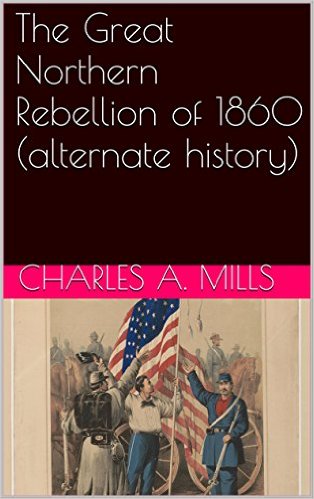
In 1860, disgruntled secessionists in the deep North rebel against the central government and plunge America into Civil War. Will the Kingdom survive? The land will run red with blood before peace comes again.


Gifts for Dogs and Dog Lovers


Wednesday, August 22, 2018

A Confederate ironclad attack on Washington D.C.?

CSS Stonewall

The Confederacy almost turned the naval balance of power around when it was the first to commission an operational ironclad. On the morning of March 8, 1862, the CSS Virginia (Merrimack) sailed toward the entrance of the James River, attacking the wooden ships of the Union fleet. Panic spread throughout Washington as news of the destruction of the wooden ships flowed into the city. Washingtonians waited to be shelled by the ironclad monster. An officer asked President Lincoln, “Who is to prevent her from dropping her anchor in the Potomac…and throwing her hundred pound shells into this room, or battering down the walls of the Capitol?” Lincoln replied, “The Almighty,” but together with members of his cabinet continued looking anxiously down the Potomac for a sign of the CSS Virginia.

Actually the heavy, ponderous Virginia, with its deep draft, was probably incapable of sailing up the Potomac. The more seaworthy CSS Stonewall, purchased in Europe and commissioned late in the war, was the type of ocean going ironclad cruiser that could have destroyed the Union blockade and bombarded Washington, Philadelphia and New York.


A brief look at love, sex, and marriage in the Civil War. The book covers courtship, marriage, birth control and pregnancy, divorce, slavery and the impact of the war on social customs.


In 1860, disgruntled secessionists in the deep North rebel against the central government and plunge America into Civil War. Will the Kingdom survive? The land will run red with blood before peace comes again.


Tuesday, August 21, 2018

Captain Kidd’s Treasures


    Here then are the simple facts of William Kidd’s descent into piracy.  Born in 1645, the son of a Scottish minister, Kidd became a merchant sailor.  In the late 1680's Kidd captained his own ship in the West Indies, attacking French shipping under the authority of a privateer's commission.  Some claim he was a pirate even at this stage, ignoring his status as a privateer and preying on the ships of all nations.  At least one legend suggests that Kidd even pirated in the China Sea during this period.  Whatever the truth of these rumors, Kidd's reputation in the colonies was excellent.  In 1691 he was employed by the Province of Massachusetts to pursue pirates off the coast of New England.  He was cited for reward and was awarded 150 pounds sterling.  Kidd's service in the West Indies the following year was equally distinguished.  Kidd had become a man of some reputation and substance in New York.

In 1695 he was visiting London when Royal officials were talking of taking steps to check the alarming activities of English and American pirates in the Red Sea.  Kidd was recommended as an able and dependable man to be sent out to round up pirates.  Kidd said he knew pirates from his "privateering" days and needed only a strong ship and good crew to master the problem.


The ADVENTURE GALLEY, a new ship of two hundred and eighty four tons and thirty four guns, was fitted out and a carefully selected crew of officers and men, nearly all family men, was put aboard.  This crew was almost immediately pressed into the navy by H.M.S.DUCHESS, which came along side in search of new crew members to refill its depleted ranks.  Kidd was forced to re-man his ship with a crew of rather dubious character.  He sailed from Plymouth in April, 1696, arriving in New York on July 4, with a French prize in tow.  Kidd stayed in New York for several months, sailing for the Red Sea in September.

Kidd cruised the waters of Madagascar and the Malabar Coast of India for months but was unable to make contact with a single pirate ship.  The crew, paid only on the basis of a percentage of the booty taken, began to grumble.  As conditions aboard the ship became intolerable through lack of food, medicine and water, the crew openly demanded that Kidd take any ships, pirate or not.

Ultimately, Kidd began pirating, seizing ships of every kind in the eastern waters.  On January 30, 1698, Kidd made his richest haul, capturing the Armenian ship QUEDAGH MERCHANT.  The captured ship was loaded with a cargo of silks, gold coins, gold bars, gold dust, silver bars, silver coins, pearls, ivory, spices, and rich cloth. 

If Captain Kidd really buried treasure in all of the places he is credited as having visited, he would have spent more time digging than sailing. Still, the legends of Kidd's treasures should not be dismissed lightly. On May 12, 1701, after sentencing, and while awaiting execution, Kidd made a desperate appeal to the House of Commons, offering to lead Royal officials to "goods and treasure to the value of one hundred thousand pounds" in exchange for a reprieve.

Legend places chests of Captain Kidd's gold in many locations in many states. In Connecticut these locations include:

Milford, New Haven County
- Charles Island off Milford
- Pilot Island off Norwalk
- Sheffield Island off Norwalk
- The Thimble Island group
- Near Middletown, Middlesex County
- Conanicut Island near old Lyme
- Clarke's Island
- On Kelsey Point in Middlesex County

In Maine:
- Wiscasset, Lincoln County


In Maryland:
- Druid Hill Park in Baltimore

In Massachusetts:
- Gold and jewels are buried near Turner Falls.

In New Jersey
- Cliffwood Beach on Raritan Bay
- Sandy Hook
- Red Bank
- Lilly Pond near Cape May Point

In New York:
- Gardiner's Island...in Kidd valley.
- Several Kidd legends center on the Hudson River:


Over one hundred legends of buried pirate treasures, and where to look for them. "...detailed descriptions of areas where treasures are thought to be buried...explanations of how the treasures originiated, and tales concerning the area of operation of the various captains. Most of the sites are in the U.S.....Legends of Pirate Gold could make that seashore vacation a new adventure." - Treasure Search Magazine


These are the stories of treasures great and small and of those who hunt for them. The book includes the world's most famous treasure cipher, sunken treasure ships, treasure caves, and tales of over fifty of the most famous lost treasures of the globe. For all who dare to go in search of golden opportunities and glittering prizes.


Monday, August 20, 2018

Confederate Coins (1861-1865)


The Confederacy made tentative steps toward coining money. Many United States silver half dollars minted in New Orleans in 1861 (1861 O) were struck by Confederates. The 1861 O quantity includes 330,000 coins struck by the U.S. government; 1,240,000 for the state of Louisiana after it seceded from the Union, and 962,633 coins struck after Louisiana joined the Confederacy. Since all of these coins were struck from U.S. dies they cannot be distinguished one from the other.


The Confederacy’s attempt to operate the New Orleans mint also accounts for some of the rarest coins in American history, the so called “Confederate half dollars.” In 1861 the Confederate government coined four silver half dollars at New Orleans using the obverse of the regular U.S. half dollar and an original Confederate design on the reverse side. The first of these Confederate half dollars was not found until 1879. The other three have yet to be found.


A brief look at love, sex, and marriage in the Civil War. The book covers courtship, marriage, birth control and pregnancy, divorce, slavery and the impact of the war on social customs.


In 1860, disgruntled secessionists in the deep North rebel against the central government and plunge America into Civil War. Will the Kingdom survive? The land will run red with blood before peace comes again.


Saturday, August 18, 2018

The Slave Auction Block


Fueled by speculation, the total value of slave property across the South in 1860 was enormous compared to other sectors of the economy. It was nearly three times larger than the total amount of capital invested in manufacturing throughout the entire country, almost three times the amount invested in all railroads, and seven times the amount invested in all banks. It was three times the value of all livestock, twelve times the value of all farm implements and machinery and forty eight times larger than the total annual expenditures of the Federal government. Slave owning Virginians worried about the loss of this huge investment. Northerners, such as Ambert Remington of New York, foretold that, “…a man that owns ten, twenty, or thirty thousand dollars in slaves, ($150,000-$450,000 in current dollars) will not give them up without a struggle….”

The case of Hickory Hill is illustrative. Hickory Hill, owned by the Wickham family, was a 3,500 acre plantation located in central Hanover County, near Richmond, Virginia. The plantation practiced the most up to date agricultural methods. The most important pillar of the Wickhams’ financial security however, was the increasing value and number of slaves at Hickory Hill. In 1852 there were two hundred slaves valued at $70,000, an average of $350 each at Hickory Hill. In 1860 there were 275 slaves, averaging slightly more than $650 each, worth $180,000. In eight years the value of the Wickham’s slave property increased two and one half times. Low crop yields were not something the Wickhams had to worry about. If the Wickhams had to endure several consecutive years of crop failures, they could always sell some of their slaves. The Wickham family was not alone however, slave owning in Virginia was not only for wealthy planters, but was quite widespread.


Slave flight, “running away,” the most common form of slave resistance, called into question the notion of benevolent paternalism and struck particularly hard at the idea that slaves were basically happy.


A brief look at love, sex, and marriage in the Civil War. The book covers courtship, marriage, birth control and pregnancy, divorce, slavery and the impact of the war on social customs.


Tuesday, June 19, 2018

Germany's Plan to Attack America in 1897


Kaiser Wilhelm II

     In November 1889, Secretary of the Navy Benjamin F. Tracy called for the rapid expansion of the United States Navy, stating that for twenty years the fleet had been neglected and become technologically obsolete.  America stood twelfth among the naval powers of the earth.  The U.S. fleet consisted of 11 armored and 31 unarmored vessels, whereas the British fleet boasted 76 armored and 291 unarmored vessels.  The German fleet had 40 armored and 105 unarmored ships.  The American fleet was outranked by even the eleventh rate navy of the Austrian-Hungarian Empire which had 12 armored and 44 unarmored ships.
In 1897 a staff officer, Lieutenant Eberhard von Mantley was ordered to draft an operational plan for a combined German naval and infantry attack on America. In the late 19th century both America and Imperial Germany were expanding in the Pacific and German military planners could envision a day when the two countries might clash. Known as Operational Plan 3, the German strategy involved a combined arms thrust against America’s strategic center of gravity, the East Coast. "Here is the core of America and it is here that the United States could be most effectively hit and most easily forced to sign a peace deal," von Mantley wrote.
Sixty German ships with troops and supplies were to make their way across the Atlantic and attack the important U.S. Naval facilities at Norfolk and Newport News, Virginia. Simultaneously, several thousand troops were to occupy Boston, while heavy cruisers bombarded Manhattan. 
The plan was scrapped in 1907, the same year that President Theodore Roosevelt sent the greatly strengthened and enlarged U.S. Navy on an around the world “goodwill” mission.  Known as the “Great White Fleet”, the mission demonstrated America’s new role as a world power.


Sun Tzu, the Master of War, once said, “Those who are skilled in producing surprises will win. In conflict, surprise will lead to victory. ” Here are four stories about the history of the world IF wars we know about happened differently or IF wars that never happened actually took place.


Including:
1.The Hostage, in which Abraham Lincoln is kidnapped by the rebels.

2.The German Invasion of America of 1889, in which Germany unexpectedly launches its might against the United States.

3.The Invasion of Canada 1933, in which the new American dictator launches a sneak attack on Canada.

4.Cherry Blossoms at Night: Japan Attacks the American Homeland (1942), in which Japan attacks the American homeland in a very surprising way.


Tuesday, June 12, 2018

The Puritans and Sex


Sex was essential to the Puritan’s notion of a healthy marriage.  Refusal to engage in sexual relations with one’s spouse could lead to a disciplinary hearing at the local church or judicial prosecution. James Mattock was excommunicated by the Boston congregation in 1640 for having, among other things, “denied conjugal fellowship unto his wife for the space of two years together.” John Williams of Plymouth Colony was summoned to court for “refusing to perform marriage duty towards (his wife) according to the law of God and man.”


The Puritans believed that both sexes should experience “delight” during sexual intercourse. According to the medical and marital advice literature of the time, procreation could not occur without female orgasm, which required that the woman become sexually aroused.  A popular marital guide of the time admonished men that,  “When the husband cometh into the wife’s chamber he must entertain her with all kind of dalliance, wanton behavior, and allurements to venery.” New England courts upheld the view that women had a right to expect “content and satisfaction” in bed; he who failed to provide it was judged “deficient in performing the duty of a husband.” Colonial Americans generally wore their shirts and shifts or more during sex. Full nudity was uncommon until much after the colonial period.


In New England, where the Puritans had defined marriage as a civil contract, secular law had provided for divorce as early as the seventeenth century.  Marriages could be ended if either party failed to meet the obligations of the contract.  Adultery, impotence, desertion, or conviction for serious crimes were all grounds for divorce.  Additionally, wives could obtain a divorce on the grounds of non-support.


Male inability to provide sexual satisfaction initially constituted grounds for divorce in New England. New Haven’s divorce statute described marital sex as “due benevolence.” It allowed a wife to divorce her husband if he proved unable “to perform or afford the same,” regardless of whether she was “fit to bear children.” A man who proved incapable of providing “that corporal communion which is reciprocally due between husband and wife” was considered nothing more than a “pretended husband.” Abstention from marital sex, wrote Edward Taylor, “denies all relief in wedlock unto human necessity” and would tempt those who lacked “the gift of continency” to engage in illicit unions. Conjugal intercourse, then, constituted a bulwark against sexual sin and chaos.


A brief look at love, sex, and marriage in colonial America and the early republic.


A brief look at love, sex, and marriage in the Civil War. The book covers courtship, marriage, birth control and pregnancy, divorce, slavery and the impact of the war on social customs.


Saturday, May 26, 2018

Civil War Humor 1861-1865


Civil War Political Cartoon

Parody was a favorite form of humor among the troops of both sides. The soldiers of the Army of Northern Virginia, often referred to as “Lee’s Army”, sometimes parodied the title of Victor Hugo’s popular novel Les Miserables and referred to themselves as, “Lee’s Miserables .”

Popular songs were a source for parody. The song Just Before The Battle, Mother (I was thinking most of you), was mangled into:

Just before the battle, Mother,
I was drinking mountain dew,
When I saw the Rebels coming
To the rear I quickly flew.

Not even prayers were spared. The classic children's 18th century prayer:

“Now I lay me down to sleep,
I pray the Lord my soul to keep,
If I shall die before I wake,
I pray the Lord my soul to take.”

was revised by Union soldiers on Burnside’s celebrated “Mud March”:

“Now I lay me down to sleep
In the mud that’s many fathoms deep;
If I’m not here when you awake,
Just hunt me up with an oyster rake.”


Despite the horrors of war, or maybe because of them, humor still had a place in American life. Abraham Lincoln best summed up the role of humor in the war when he said, “With the fearful strain that is on me night and day, if I did not laugh I should die.”

A brief but fascinating look at humor in the Civil War including: (1) Stories Around the Campfire, (2) Parody, (3) the Irish, (4) Humorous Incidents, (5) Civil War Humorists, and (6) Lincoln.


Friday, May 25, 2018

George Armstrong Custer: Influence of the Battle of the Washita

CUSTER


     It was during the campaign of 1868 that George Armstrong Custer distinguished himself as an Indian fighter at the Battle of the Washita (Oklahoma).  The formal order directing operations to commence came in the shape of a brief letter of instructions from Department headquarters.  “…as nothing was known positively as to the exact whereabouts of the Indian villages, the instructions (had) to be general in terms.  In substance, I was to march my command in search of the winter hiding places of the hostile Indians and wherever found to administer such punishment for past depredations as my force was able.”

     Major Joel Elliott located the Indian trail.  Custer writes, “We…at once set out to join in the pursuit, a pursuit which could and would only end when we overtook our enemies.  And in order that we should not be trammeled in our movements it was my intention then and there to abandon our train of wagons, taking with us only such supplies as we could carry on our persons and strapped to our saddles….”  The battle of the Washita commenced with the regimental band playing Gary Owen as, “the bugle sounded the charge and the entire command dashed rapidly into the village.  The Indians were caught napping….”

     The actual possession of the village and its lodges was achieved within a few moments, but now on all sides Indians began gathering around Custer’s command.   Custer writes, “Making dispositions to overcome any resistance which might be offered to our advance by throwing out a strong force of skirmishers, we set out down the valley in the direction where the other villages had been reported and toward the hills on which were collected the greatest number of Indians.”  By prominently displaying captive women and children hostages, Custer was able to force the Indians to disengage.  “Whether the fact that they could not fire upon our advance without endangering the lives of their own people, who were prisoners in our hands, or some other reason prevailed with them, they never offered to fire a shot or retard our movements in any manner, but instead assembled their outlying detachments as rapidly as possible, and began a precipitate movement down the valley”

      Understanding Custer’s state of mind and tactics at the Washita is essential to understanding his later actions on the Little Bighorn: (1) the central problem in this type of irregular warfare was catching the enemy, Indians would scatter rather than fight, and (2) Indians would not endanger their women and children (Custer wrote, “Indians contemplating a battle, either offensive or defensive, are always anxious to have their women and children removed from all danger thereof.”)  Clearly, based on his earlier experiences Custer expected the Indians at the Little Bighorn to run.  In any event, he meant to bring them to heel by taking women and children hostages.  His swing to the north of the village was designed to accomplish this one thing.


Battle of the Washita from "Little Big Man"


Views of Custer have changed over succeeding generations. Custer has been portrayed as a callous egotist, a bungling egomaniac, a genocidal war criminal, and the puppet of faceless forces. For almost one hundred and fifty years, Custer has been a Rorschach test of American social and personal values. Whatever else George Armstrong Custer may or may not have been, even in the twenty-first century, he remains the great lightning rod of American history. This book presents portraits of Custer and the Battle of the Little Bighorn as they have appeared in print over successive decades and in the process demonstrates the evolution of American values and priorities.